
Greece Prepares for Subsea Power Cable Project Amid Turkish Tensions
Translated & summarized from N12 by baba
Greece is moving forward with its Interconnector subsea power cable project connecting to Cyprus and Israel, with a French survey ship set to begin work south of Crete. This has led to conflicting maritime warnings from Greece and Turkey, highlighting ongoing disputes over maritime borders. Turkey opposes the project as it crosses territory claimed under its "Blue Homeland" doctrine. Greece, bolstered by recent defense purchases, appears more determined to proceed, potentially involving the US and France to pressure Turkey.
The story in 6 lines · by baba
- Greece is proceeding with its Interconnector power cable project linking to Cyprus and Israel.
- France's survey ship 'Abeille Maringo' will soon conduct surveys south of Crete.
- Greece and Turkey have issued conflicting maritime warnings (NAVTEX) in the same area.
- Turkey opposes the project, citing its "Blue Homeland" maritime doctrine and a 2019 border agreement with Libya.
- Greece appears more resolute due to recent significant defense acquisitions from Israel.
- Greece may involve the US and France to pressure Turkey regarding the project.
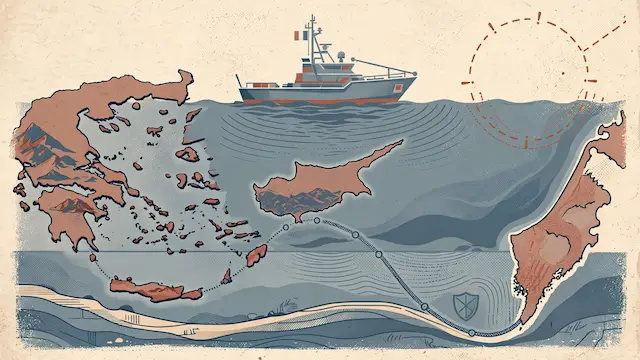
Greece is preparing to resume work on the Interconnector project, a high-voltage subsea power cable intended to link its electricity grid with Cyprus and Israel. As part of this preparation, the French survey ship "Abeille Maringo" is expected to conduct marine surveys in the region soon. This move, however, risks opening a new front with Turkey, as Athens and Ankara have conflicting views on maritime borders, including those of Cyprus. The potential clash point is south of Crete.
The heightened tensions were evident over the past weekend. On Thursday, Greece announced a closed sea area (NAVTEX) south of Crete for a military exercise involving Cyprus, France, and Italy. Turkey, viewing this area as under its jurisdiction, responded with a counter-NAVTEX announcement. "NAVTEX is a warning to sailors to stay away, as the military may conduct exercises that could damage ships," explained Dr. Haim Itan Cohen Yanarocak, an expert on Turkey at Tel Aviv University and the Jerusalem Institute for Strategy and Security.
This is not the first time Turkey has shown assertiveness regarding the project. About 18 months ago, Greece ignored threats from the Erdogan administration and declared a closed sea area to begin cable laying between Rhodes and Crete. An Italian ship arrived at the work site, but operations were repeatedly postponed due to Turkish threats to cut the cables, leading Athens to avoid unilateral action for fear of military confrontation. However, Greece has since made significant defense acquisitions from Israel worth billions of dollars, appearing more resolute this time.
Ankara strongly opposes the Interconnector project because it is slated to pass through an area covered by the 2019 Turkish-Libyan maritime border agreement, a key element of Erdogan's "Blue Homeland" vision. This agreement, which created a shared maritime border between Turkey and Libya at the expense of Greek maritime territory, is part of Turkey's neo-Ottoman maritime doctrine aiming for dominance in the Eastern Mediterranean and beyond. Turkey's Deputy President Cevdet Yılmaz announced on Friday that Turkey's defense budget for 2027 will see a 229% increase in arms procurement, indicating a continued assertive stance.
Dr. Cohen Yanarocak stated that the Turks are determined to prevent the cable's deployment without their consent, demanding negotiations with Greece, which he deems unlikely. He noted that the Law of the Sea convention favors Greece, which has the backing of the European Union, and thus Athens has no reason to back down. Greece is expected to involve additional players like the United States and France to pressure Turkey.
Mentioned
The same event, reported separately by each outlet. Open a few to compare what different newsrooms emphasize — and what they leave out.
Centre 1Other 1


Not the same event — other stories that share this one’s people, places, or theme: background, reactions, and follow-ups.
