
Economists Warn Jewish Terror and Settlement Activity Threaten Israel's Economy
Translated & summarized from Ynet by baba
Over 60 Israeli economists have warned that Jewish terror and settlement activity, particularly in the E1 area, threaten Israel's economy. They cite international actions like potential import bans and sanctions from countries including Britain, France, and Canada as a warning sign. The economists predict severe economic repercussions, including a rise in the cost of living and potential job losses for thousands of Palestinian workers in West Bank industrial zones. The Forum urges a policy change to prevent Israel's isolation and protect its vital economic ties with the world.
The story in 6 lines · by baba
- Over 60 Israeli economists warn Jewish terror and settlement activity threaten Israel's economy.
- International actions against settlements, including potential import bans and sanctions, are a warning sign.
- Economists predict heavy economic costs for all Israelis, including a rise in the cost of living.
- Thousands of Palestinian workers in West Bank industrial zones may lose their jobs due to sanctions.
- The Forum calls for a policy change to prevent Israel's isolation and protect its global economic ties.
- Britain, France, and Canada are among countries considering or implementing measures against settlements.
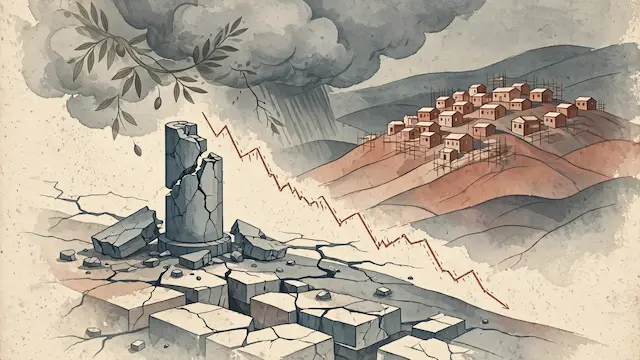
More than 60 Israeli economists, academics, and former public service officials have signed a warning letter from the Forum of Economists, asserting that international actions against settlements serve as a warning sign for Israel's economy. They contend that Jewish violence and terror against Palestinians will impose a heavy economic cost on all Israeli citizens. The signatories point to Britain's announcement of plans to ban imports from settlements and consider sanctions against companies and individuals aiding their expansion, alongside similar measures in the Netherlands and intentions in countries like France and Canada. The immediate context cited is construction in the E1 area and Jewish terror in the West Bank, perceived as government-backed, with the broader background being government policy, particularly concerning Gaza post-October 7th.
The economists warn that the damage to the Israeli economy could worsen significantly if such measures expand from a few countries to a substantial part of Europe and spread from settlements to the entire Israeli economy. This raises concerns about a serious deterioration in economic relations between Israel and Europe, leading to significant macroeconomic damage. The letter notes a growing momentum for sanctions and private sector initiatives globally, with approximately 100 sanctions already imposed by over 50 countries. The economists believe these sanctions will lead to a substantial increase in the cost of living, exacerbating an already recognized problem in Israel.
The Forum calls for a policy change to prevent Israel's deepening isolation and mitigate economic damage. They emphasize that continued construction in E1 and the failure to prevent Jewish terror endanger Israel's vital economic relations with the world and the entire economy. The signatories include prominent figures such as David Harel, President of the Israel National Academy of Sciences; Yakov Frenkel, Israel Prize laureate and former Governor of the Bank of Israel; former Deputy Governors Zvika Akstein and Avia Spivak; former heads of the Bank of Israel's Research Division Leo Leiderman and Michel Strawczynski; former Supervisor of Banks Yair Avidan; and former Director Generals of the Ministry of Finance Avraham Ben-Bassat, David Brodet, and Yarom Ariav, as well as former National Economic Council head Manuel Trajtenberg.
According to industry sources and economists, Palestinian workers are expected to be the immediate victims of sanctions, with an estimated 4,000 out of 18,000 legally employed Palestinians in Israeli industrial zones in the West Bank potentially losing their jobs. Some factories may close or relocate. The Ministry of Economy and Industry reports a sharp decline in foreign orders and the cancellation of long-term distribution contracts, with fears of losing markets in Western Europe. The report also references a Palestinian report of settlers blocking a vehicle carrying foreign activists, and data from the Jewish People Policy Institute (JPPI) indicating 121 restrictive measures against Israel in 62 countries, with Spain, the US, the UK, Belgium, and Turkey leading in the number of actions.
Mentioned
The same event, reported separately by each outlet. Open a few to compare what different newsrooms emphasize — and what they leave out.
Centre 1Other 1

Not the same event — other stories that share this one’s people, places, or theme: background, reactions, and follow-ups.




