
Hamas Extortion Disrupts Gaza Trade, Israel Warns
Translated & summarized from Makor Rishon by baba
Private traders in Gaza have stopped coordinating goods entry due to Hamas's extortion demands, halting about half of the weekly truck traffic. Israel's Coordinator of Government Activities in the Territories warned that Hamas is using the trade for its own buildup and that this could endanger the ceasefire. Humanitarian aid will continue to enter Gaza via international bodies, though at a reduced volume compared to the ceasefire agreement's target.
The story in 6 lines · by baba
- Gaza traders halted goods entry due to Hamas demanding 10,000 shekels per truck.
- Hamas is also demanding 30% of goods be sold for cash, bypassing bank transfers.
- Israel's COGAT warned Hamas is exploiting trade for economic and military buildup.
- The private sector accounts for half of Gaza's weekly truck entries.
- Humanitarian aid will continue via the UN and other organizations.
- Israel urged international officials to prevent Hamas interference in goods entry.
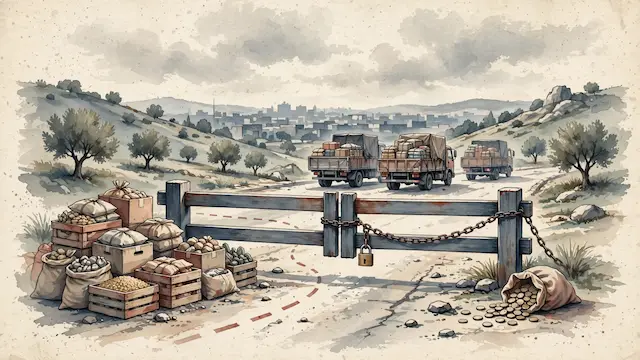
Private sector traders in the Gaza Strip have halted the coordination of goods entering the territory starting Wednesday, due to threats from Hamas. The militant group is demanding approximately 10,000 shekels for each truckload of goods. This action was revealed in an unusual letter sent by the Coordinator of Government Activities in the Territories (COGAT), Maj. Gen. Yoram Levy, to senior international community officials.
COGAT warned that Hamas is exploiting the entry of goods for its economic and military buildup, and that the traders' work stoppage could jeopardize the implementation of the ceasefire agreement. Reports indicate that Hamas security forces detained the son of a trader who refused to pay the extortion fees. The son was taken to Abbas prison, causing significant fear among other traders who subsequently decided to stop coordinating truck entries for their safety.
According to trader reports, Hamas's demands extend beyond the per-truck fee. They are also requiring traders to sell about 30% of their goods for cash, bypassing bank transfers. COGAT believes this is an attempt by Hamas to seize funds, contradicting the traders' commitments to use only the banking system for all payments. The extortion mechanism has reportedly expanded to sub-traders and is intended to be applied even to drinking water supplies.
The cessation of private sector trade could have broad implications, as the private sector accounts for roughly half of all weekly truck entries into Gaza. This could hinder Israel's ability to meet the ceasefire agreement's target of 600 trucks per day. Maj. Gen. Levy has contacted UN Special Envoy for Gaza, Nikolai Mladenov, International Stabilization Force Commander Maj. Gen. Jesper Jeffers, and UN Humanitarian Coordinator Ramiz Alakbarov, urging them to intervene and prevent Hamas from exploiting the goods entry mechanism.
Levy also cautioned against Hamas attempting to blame Israel for any shortages and for violating the ceasefire. He asserted that Hamas bears responsibility for disrupting the flow of goods due to its threats and financial demands on traders. Despite the private traders' halt, COGAT confirmed that humanitarian aid will continue to enter Gaza via the UN, international organizations, and donor countries, including winter supplies. COGAT estimates that approximately 250 aid trucks per day through these channels are sufficient for the population's humanitarian needs, though this is significantly below the 600-truck daily target set in the ceasefire agreement.
Mentioned
The same event, reported separately by each outlet. Open a few to compare what different newsrooms emphasize — and what they leave out.
Centre 4Right 4Haredi 1Other 1










Not the same event — other stories that share this one’s people, places, or theme: background, reactions, and follow-ups.


