
Ancient Jewish Hideouts and Byzantine Church Open to Public in Israel
תומצת מתוך Makor Rishon על ידי baba
An archaeological site in Israel's Judean lowlands, Khirbet Burgin, has opened to the public, featuring hideout tunnels from the Roman period, a Byzantine church, and ancient burial systems. The site, developed by KKL-JNF and the Antiquities Authority, was previously damaged by antiquities looters. Officials highlighted its historical significance and potential to boost tourism, emphasizing the importance of preserving and making such sites accessible to the public.
הידיעה ב-5 שורות · תקציר של baba
- Ancient Jewish hideout tunnels and a Byzantine church are now open to the public at Khirbet Burgin in Israel.
- The site reveals evidence of settlement from the Second Temple period through the Ottoman era.
- Hideout systems were used by Jewish rebels during the Roman period and the Bar Kokhba revolt.
- Antiquities looters had previously damaged the site before preservation and development efforts.
- The opening is expected to enhance rural tourism in the Mateh Yehuda region.
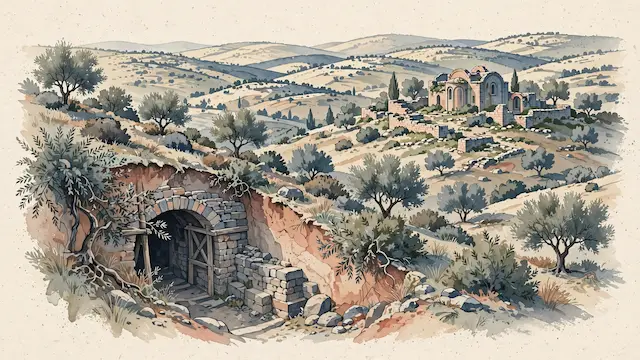
An archaeological complex featuring hideout tunnels used by Jewish rebels against the Romans nearly 2,000 years ago, a Byzantine church with colorful mosaic floors, and ancient burial systems has opened to the public in Khirbet Burgin, within the Adulam-France Park in the Judean lowlands. The site, which contains remains from various historical periods in the Land of Israel, was unveiled after excavation, preservation, and development work by KKL-JNF, the Israel Antiquities Authority, and the Mateh Yehuda Regional Council.
Archaeological excavations led by Dr. Amir Ganor, Alon Klein, and Dr. Peter Gendelman from the Antiquities Authority revealed evidence of a settlement that existed for centuries, from the Second Temple period to the Ottoman era. During the Second Temple period, a large Jewish village, possibly identified with the village of Bish mentioned by historian Josephus Flavius, was located here. In the early Roman period, extensive hideout systems were carved beneath the settlement, used by residents preparing for conflict with the Romans. The village was damaged and destroyed during the Bar Kokhba revolt.
Later, a pagan population settled the area, constructing new buildings and excavating elaborate underground burial systems. During the Byzantine period, a magnificent church with a colorful mosaic floor was built, alongside a monastery complex. Excavations also uncovered columbarium facilities for pigeon breeding and numerous wine presses, indicating the inhabitants' involvement in agriculture and wine production.
For years, the archaeological site was threatened by antiquities looters who damaged the historical remains. Dr. Amir Ganor stated that Khirbet Burgin is the largest ancient settlement in the area in terms of size and the scope of its remains, and that it suffered from intensive looting. He added that joint enforcement operations by the Antiquities Authority and KKL-JNF, along with excavations and site accessibility development, have halted the damage. "The site has been saved, and now, after preservation work, it can be enjoyed by the country's residents," he said.
KKL-JNF Chairman Eyal Ostrovsky emphasized the importance of preserving the site as part of Israel's heritage. Ami Shahar of the Antiquities Authority highlighted that exposing the findings is just the first step, with the responsibility to ensure their long-term preservation. Head of the Mateh Yehuda Regional Council, Avishai Cohen, noted that the site's accessibility is expected to boost rural tourism. Minister of Heritage Amihai Eliyahu remarked that the hideout tunnels are a testament to the Jewish struggle against the Romans and that developing heritage sites allows the younger generation to tangibly connect with the country's history.
מוזכרים
אותו אירוע, כפי שכל מערכת דיווחה עליו בנפרד. פתחו כמה דיווחים כדי להשוות מה כל מערכת מדגישה, ומה היא משאירה בחוץ.
שמאל 1מרכז 3ימין 3חרדית 1אחרים 1









לא אותו אירוע: ידיעות אחרות שחולקות עם הידיעה הזו אנשים, מקומות או נושא. רקע, תגובות והמשכים.
