
Election Day in Israel: Your Rights and Obligations as an Employee
Election Day in Israel is a paid day off for most workers, though essential services will operate normally. Employees working on this day are typically compensated at double their usual rate, a practice stemming from labor court interpretations and employer group recommendations. Eligibility for paid time off requires at least 14 consecutive days of employment prior to the election. Employers are prohibited from influencing employees' voting choices or inquiring about their political preferences.
הידיעה ב-6 שורות · תקציר של baba
- Election Day is a paid day off for most Israeli workers, with exceptions for essential services.
- Workers required to work on Election Day are generally compensated at 200% of their normal pay.
- Eligibility for paid Election Day off requires at least 14 consecutive days of employment.
- Employers cannot coerce employees' votes or inquire about their political preferences.
- Non-Israeli workers in specific sectors have different arrangements for Election Day.
- The right to a day off is not dependent on proof of voting.
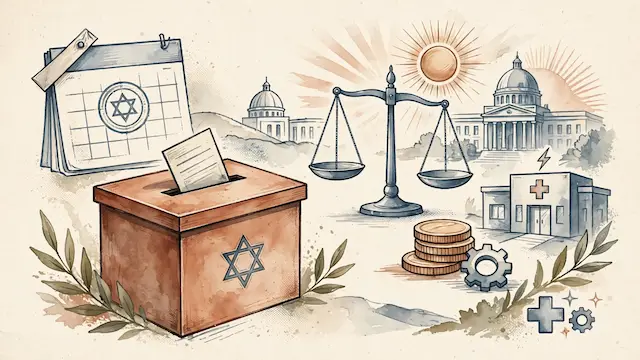
Election Day in Israel is officially a paid day off for most workers, according to the Ministry of Labor. However, certain public services, including transportation, communication, restaurants, and essential services, are exempt and will operate as usual. Employers generally require employee consent to work on this day, unless the job falls under the essential services category.
Employees who are required to work on Election Day are entitled to their regular pay for the day off, in addition to their wages for the hours worked. While the law doesn't explicitly mandate double pay, a widespread practice, supported by labor court rulings and employer organizations, results in workers receiving 200% of their normal pay for hours worked. Alternatively, with mutual agreement, employers can offer regular pay plus an additional paid day of vacation.
To be eligible for paid time off, employees must have worked for at least 14 consecutive days prior to Election Day. This entitlement applies to all workers, including hourly and part-time employees. The right to a day off is not contingent on actually voting, and employers cannot demand proof of voting.
Special arrangements apply to non-Israeli citizens working in specific sectors like nursing, hospitality, catering, construction, agriculture, and industry. These workers receive their regular pay if they work on Election Day but are generally not entitled to paid time off if they don't work, unless covered by other leave provisions.
Employers are advised against inquiring about employees' voting intentions or political preferences to avoid potential discrimination. Furthermore, employers are prohibited from using job security, termination, or threats to influence an employee's vote or to coerce political activity.
מוזכרים
לא אותו אירוע: ידיעות אחרות שחולקות עם הידיעה הזו אנשים, מקומות או נושא. רקע, תגובות והמשכים.




