
Israel to Introduce Driverless Metro Trains Within a Decade
Translated & summarized from Kikar HaShabbat by baba
Israel is preparing to launch driverless metro trains in the Gush Dan region within the next decade, as part of a massive 180 billion shekel metro project. The "Infra 2" tender, worth 30 billion shekels, will select providers for the autonomous systems. These trains will operate with the highest level of automation (GoA4), managing themselves independently. Experts highlight the technological advancements and challenges, including cybersecurity and liability, while also noting the potential to revolutionize autonomous transportation in Israel.
The story in 6 lines · by baba
- Israel plans to introduce fully autonomous metro trains in the Gush Dan region within the next decade.
- The Gush Dan metro project is valued at approximately 180 billion shekels, with a key tender worth 30 billion shekels.
- The trains will operate at the highest automation level (GoA4), requiring no human intervention in the cabin.
- A distributed artificial intelligence architecture will enable trains to function autonomously during emergencies and communication loss.
- Experts discuss challenges including cybersecurity, insurance, and liability for the autonomous metro system.
- The first section of the metro is scheduled to open in 2037, with the full project completion around 2040.
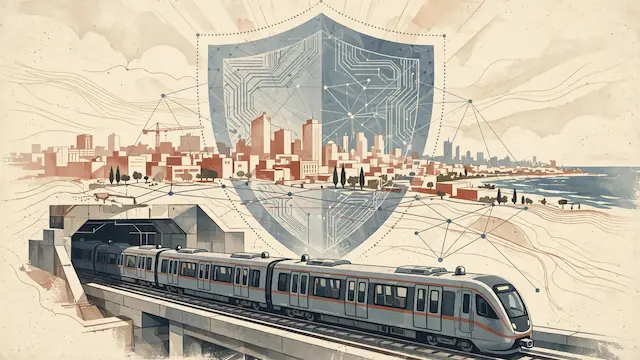
Israel is set to introduce fully autonomous metro trains within the next decade, with the first driverless services expected to begin in the Gush Dan region in just over ten years. The core technology for the Gush Dan metro, a project estimated to cost around 180 billion shekels, is being procured through the "Infra 2" tender, managed by NTA Metropolitan Mass Transit System Ltd. This significant tender, valued at approximately 30 billion shekels, will select the provider for the metro's essential systems, including the trains, signaling, control, power, communication, and station systems, as well as operational and maintenance services.
The autonomous trains will operate at GoA4 automation level, the highest in the industry, meaning no driver will be present in the cabin and the system will manage train movement independently. This technology is already in use in cities like Singapore and the UAE. Globally, over 2,279 kilometers of driverless metro lines are currently operational in 60 cities, a substantial increase from just 13 cities in 2000. Israel's adoption of this technology places it among nations embracing advanced autonomous transit.
Amit Livny, Vice President for Israel and Business Development at Mer Group, views the metro project as a pivotal moment for Israel's transition to autonomous transportation. He described the metro as a symbol of this shift, emphasizing that the trains will be completely independent and represent the forefront of global metro technology. Livny anticipates this automation will eventually extend to private cars, buses, and aviation.
The Gush Dan metro project will encompass three lines (M1, M2, M3) spanning approximately 150 kilometers with 109 underground stations across 24 municipalities, projected to serve around 600 million journeys annually. The first section is slated for a 2037 opening, with the entire project expected to conclude around 2040. Initial work on depot facilities has begun, and tunnel excavation is scheduled to commence in about 18 months.
A key challenge is ensuring the system can operate autonomously even during emergencies, malfunctions, or communication outages. Livny explained that the system will utilize a distributed artificial intelligence architecture, with decision-making capabilities embedded throughout the network rather than relying on a single central computer or cloud service. This decentralized approach ensures functionality and self-regulation even if connectivity is lost.
Dr. Mor Caspi, Head of the Shlomo Shmelzer Institute for Smart Transportation at Tel Aviv University, highlighted that the controlled environment of a metro system, running on dedicated tracks and managed from a control room, makes it less complex than autonomous road vehicles. However, she noted that questions remain regarding cybersecurity, insurance, and liability in case of accidents, as well as the potential impact on road congestion if autonomous vehicles increase private car usage. Caspi stressed the need for courage in policy-making to implement shared autonomous transport solutions and avoid increased traffic.
Keep up with
Mentioned
The same event, reported separately by each outlet. Open a few to compare what different newsrooms emphasize — and what they leave out.
Haredi 1Other 1
