
Iran Unveils Underground Missile City Amid Regional Tensions
Translated & summarized from Kikar HaShabbat by baba
Iran revealed footage of an underground "missile city" and issued threats amid rising regional tensions. The IRGC claimed readiness for action and warned of severe responses. The U.S. and Iran exchanged claims regarding drone and aircraft incidents near the Strait of Hormuz. Iranian Foreign Minister Abbas Araghchi discussed potential talks, while U.S. President Donald Trump stated he is not rushing to a decision on Iran. A senior Israeli official suggested the U.S. is preparing for significant strikes on Iranian infrastructure.
The story in 6 lines · by baba
- Iran unveiled an underground "missile city" and issued threats amid heightened regional tensions.
- The IRGC claimed readiness for action and warned of severe responses to any violations.
- Iran and the U.S. exchanged conflicting claims regarding drone and fighter jet incidents near the Strait of Hormuz.
- Iranian Foreign Minister Abbas Araghchi stated Iran is open to talks if its demands are met.
- U.S. President Donald Trump indicated he is not in a hurry to make decisions regarding Iran.
- A senior Israeli official suggested the U.S. is preparing for significant strikes on Iranian infrastructure.
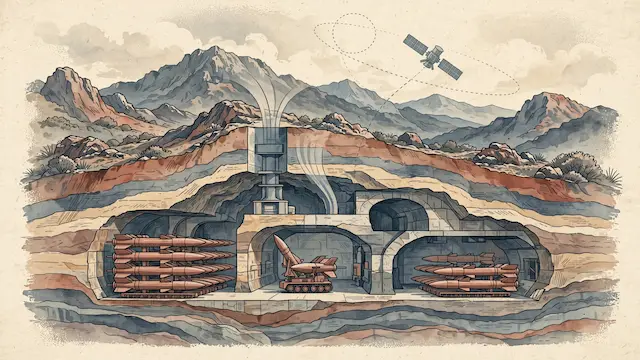
Iran revealed footage on Saturday of what it described as an underground "missile city," sending a threatening message amid heightened regional tensions and fears of renewed attacks. The Islamic Revolutionary Guard Corps (IRGC) claimed its forces are prepared for action in any arena and possess high-impact weapons. They warned that force would be used without hesitation and that this display was only the beginning of a more severe response.
The unveiling occurred during a period of intense conflict around the Strait of Hormuz, a vital oil and cargo shipping route. Iranian reports indicated that oil tankers in the southern part of the strait were hit by naval mines, suffering explosions and fires near the port of Asaluyeh and the island of Qeshm. The IRGC navy asserted that the vessels were operating in unauthorized lanes and with U.S. military backing, warning that any rule violations in the Strait of Hormuz and the Persian Gulf would be met with a response.
Simultaneously, Iran claimed its air defense systems intercepted a U.S. MQ-9 drone west of the Strait of Hormuz, which was allegedly used for surveillance. The IRGC also claimed to have hit an American F-16 fighter jet, though U.S. Central Command vehemently denied this, calling the claim false and stating all American fighter jets in the Middle East are safe.
Iranian Foreign Minister Abbas Araghchi addressed diplomatic efforts, stating Iran is ready for talks on any schedule and that a previous proposal from late October remains on the table, provided its demands are met and the U.S. fulfills specific prior commitments. He emphasized that Iran has two red lines regarding nuclear material: it must not leave the country, and its use must align with Iran's needs. Araghchi also noted that the current "neither war nor peace" situation is unsustainable and that mediators are conveying messages between the parties.
U.S. President Donald Trump commented on Iran, suggesting the country desires a deal but is unwilling to accept terms he finds acceptable. He reiterated that Iran will never be allowed to possess nuclear weapons and is monitoring potential "dirty bomb" development, warning of a U.S. response if such an action occurs. A senior Israeli security official suggested Trump is adopting a "superpower approach," waiting for the U.S. military buildup in the region to conclude before making a decision on potential strikes against Iran. This official indicated that current plans being considered involve deep strikes on Iran's national and strategic infrastructure, not just specific military or nuclear targets, to cripple the regime's functioning. Israel is reportedly on high alert, with one Israeli source stating the chances of action are increasing. Trump told a News 12 correspondent that he is "not in a hurry to make any decision regarding Iran."
Meanwhile, Israeli Ambassador to the U.S. Yechiel Leiter stated that "American soldiers will return home to their families in the United States when Iran is defeated," a remark that drew sharp criticism from Iran's Foreign Minister. Western sources told News 12 that Mossad chief Roman Gofman provided concrete information during a U.S. visit indicating progress in Iran's nuclear program and other unspecified Iranian activities, including potential chemical and biological weapons development. Israeli security officials currently have no information about Iran's operational capabilities in these areas.
Mentioned
The same event, reported separately by each outlet. Open a few to compare what different newsrooms emphasize — and what they leave out.
Centre 1Right 1Haredi 2Arab 1Other 1






Not the same event — other stories that share this one’s people, places, or theme: background, reactions, and follow-ups.


