
Dollar Surges Past 3.30 Shekels for First Time in Over a Year, Experts Warn of New Inflation Wave
Translated & summarized from Alarab by baba
The US dollar climbed past 3.30 Israeli shekels for the first time in over a year on Thursday evening, reaching its lowest point in twelve months. Experts cite a widening interest rate gap, political uncertainty, global dollar strength, and a slowdown in the high-tech sector as key reasons. While the weaker shekel benefits exporters, it raises import costs and the cost of living for consumers. Analysts predict potential stabilization, with some suggesting a stable government could return the dollar to 3 shekels.
The story in 6 lines · by baba
- The US dollar exceeded 3.30 Israeli shekels for the first time since October 2025.
- Experts attribute the shekel's decline to interest rate differences and political uncertainty.
- Global dollar strength and a slowdown in Israel's high-tech sector are also contributing factors.
- The rising dollar increases import costs and inflation, impacting consumers.
- Exporters and dollar-earning companies benefit from the weaker shekel.
- Some analysts believe a stable government could lower the dollar to 3 shekels.
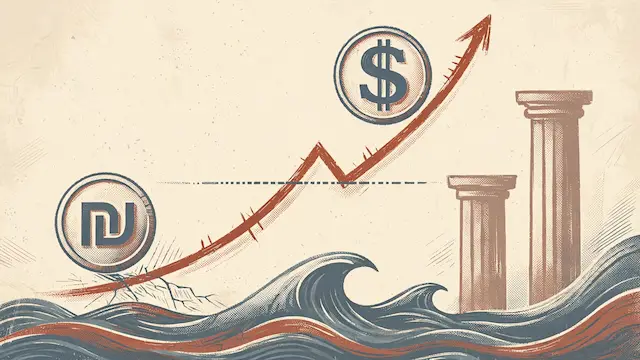
The US dollar surpassed 3.30 Israeli shekels on Thursday evening, reaching its highest point against the Israeli currency in over a year. This marks the first time the dollar has crossed this threshold since October 2025, pushing the shekel to its lowest value in more than twelve months. The official exchange rate had been set earlier that day at 3.282 shekels, representing a 0.64% increase from the previous day. The dollar has now climbed approximately 18% since hitting a low of 2.80 shekels about six months ago.
Experts attribute the shekel's decline to several factors. Moody Shafrir, Chief Strategist at Bank Hapoalim, pointed to the widening interest rate gap, with US rates expected to rise while Israeli rates are anticipated to remain stable or even decrease, especially after October's inflation data came in lower than expected. Shafrir also cited political uncertainty and the risk of new elections, noting that market concerns about Gadi Eisenkot's ability to form a government have increased Israel's risk premium, a scenario described as detrimental to the economy.
Further contributing factors include the global strength of the dollar, which has reached multi-month highs against other major currencies like the Euro and British Pound. Additionally, the tech sector's slowdown, evidenced by a significant shake-up at Nvidia following its founder Jensen Huang's surprise resignation and weaker-than-expected labor market data in the high-tech sector, is impacting the Israeli economy. The article notes Nvidia's substantial weight in Israel's GDP.
Experts warn that the dollar's rise is a double-edged sword. While it increases the cost of imports, consumer goods, and dollar-denominated travel, fueling inflation and raising the cost of living, it benefits Israeli exporters, high-tech companies, and security industries earning revenue in dollars, as well as those holding dollar-denominated assets abroad.
Looking ahead, Yossi Manashy, Co-Founder and Co-CEO of Altshuler Shaham Financial Services, doubts the Bank of Israel will intervene to halt the shekel's decline unless irrational market movements occur. He anticipates the exchange rate may stabilize after the recent rapid increase. Conversely, Shafrir relayed that foreign investment managers in London believe stabilizing the government under Eisenkot could push the dollar back down to around 3 shekels.
Mentioned
The same event, reported separately by each outlet. Open a few to compare what different newsrooms emphasize — and what they leave out.
Centre 2Haredi 1Arab 1Other 1





Not the same event — other stories that share this one’s people, places, or theme: background, reactions, and follow-ups.



