
Dollar Surpasses NIS 3.30 for First Time in Over a Year
Translated & summarized from Mako by baba
The U.S. dollar rose above 3.30 shekels for the first time in over a year, marking an 18% increase from its low six months ago. Analysts cite widening interest rate gaps, increased political and security risk premiums, and global dollar strength as key drivers. The weaker shekel is expected to increase the cost of living and impact sectors like air travel, while benefiting dollar asset holders and exporters. The Bank of Israel is not expected to intervene unless economic logic is violated.
The story in 6 lines · by baba
- Dollar surpasses NIS 3.30 for first time since October 2025, reaching a one-year low for the shekel.
- The dollar has strengthened by approximately 18% against the shekel in the past six months.
- Widening interest rate gaps and increased risk premiums are major factors weakening the shekel.
- Political uncertainty, including potential new elections, is seen as a significant negative economic factor.
- A stronger dollar is expected to increase inflation and the cost of living in Israel.
- Foreign investors believe the dollar could fall to 3 shekels if a new government is formed.
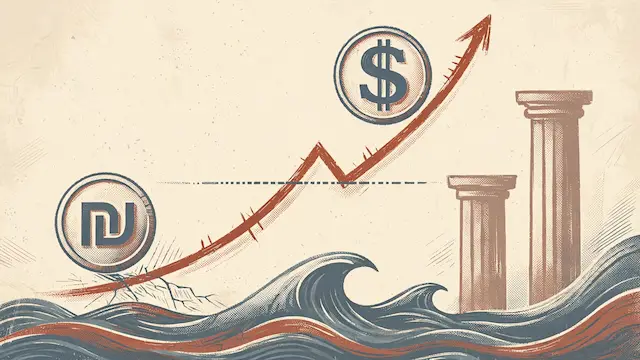
The U.S. dollar crossed the 3.30 shekel threshold in continuous trading on Thursday, marking the first time it has reached this level since October 2025 and pushing the Israeli shekel to a more than one-year low. Earlier, the representative exchange rate was set at 3.282 shekels, a 0.64% increase from the previous day. The American currency has appreciated approximately 18% since hitting a low of 2.80 shekels about six months ago.
Analysts point to several factors contributing to the shekel's weakening. Yossi Menashe, founder and co-CEO of Altshuler Shaham Financial Services, highlights the widening interest rate gap between Israel and the U.S. as a significant driver. While U.S. rates are trending upward, Israel's central bank is under pressure to lower its rate, especially after a lower-than-expected inflation index for October. The Chief Strategist at Bank Hapoalim, Chief Strategist at Bank Hapoalim, attributes the decline to an increased risk premium on Israel, meaning investors demand higher yields to invest in the country. This is partly fueled by concerns that Gadi Eisenkot, the chairman, may not succeed in forming a government, increasing the likelihood of new elections, which are seen as detrimental to the economy.
Adding to the instability, the dollar is also strengthening globally against the Euro and Pound Sterling, with the dollar index reaching its highest level since April 2025. Menashe notes that the shekel, once an outlier, now moves with global trends. He also points to the turmoil at Nvidia following its founder Jensen Huang's abrupt departure as CEO as a factor contributing to uncertainty, given Nvidia's significant role in the Israeli economy. The high-tech labor market is also showing signs of cooling, with more job seekers than available positions reported by the Employment Service.
The weaker shekel has implications for the Israeli economy and consumers. Menashe explains that since most goods are imported in dollars, a stronger dollar can trigger inflation and increase the cost of living. This presents a dilemma for the Bank of Israel: a higher dollar raises prices but benefits exporters. Airline tickets, priced in dollars, become significantly more expensive in shekel terms, even if the dollar price remains unchanged. Conversely, those holding dollar-denominated assets abroad, including Israeli citizens and institutional investors, benefit from the trend, as do Israeli tech and defense companies with dollar revenues.
Looking ahead, Menashe anticipates that the Bank of Israel will likely not intervene in the currency market unless an illogical economic movement occurs, as the bank typically buys dollars to strengthen the shekel, not intervene based on a specific rate. He estimates that the dollar may stabilize after its recent rapid appreciation, but this depends on numerous external factors. The Chief Strategist at Bank Hapoalim suggests that the formation of a new government committed to structural reforms could shift investor sentiment. He also relays that foreign investment managers in London estimate the dollar could fall back to around 3 shekels if Eisenkot successfully forms a government.
Mentioned
The same event, reported separately by each outlet. Open a few to compare what different newsrooms emphasize — and what they leave out.
Centre 2Haredi 1Arab 1Other 1





Not the same event — other stories that share this one’s people, places, or theme: background, reactions, and follow-ups.




