
Ancient Jewish Hideouts and Byzantine Church Reopen in Israel's Judean Foothills
Translated & summarized from Walla by baba
The ancient archaeological site of Khirbet Burgin in Israel's Judean Foothills has reopened after preservation work by the Israel Antiquities Authority and the Jewish National Fund. The site features Second Temple-era Jewish hideouts used during Roman times, Byzantine church ruins with mosaics, and burial caves. The reopened complex offers visitors a 2.5-kilometer walking trail showcasing the area's rich history, with efforts made to combat antiquities looting and enhance public access.
The story in 5 lines · by baba
- Khirbet Burgin, an ancient site in Israel's Judean Foothills, has reopened after preservation work.
- The site includes Jewish hideouts from the Roman period and a Byzantine church with mosaics.
- Archaeologists uncovered a long settlement history from the Second Temple to Ottoman eras.
- Preservation efforts aimed to combat antiquities looting and make the site publicly accessible.
- A 2.5-kilometer walking trail guides visitors through caves, ruins, and viewpoints.
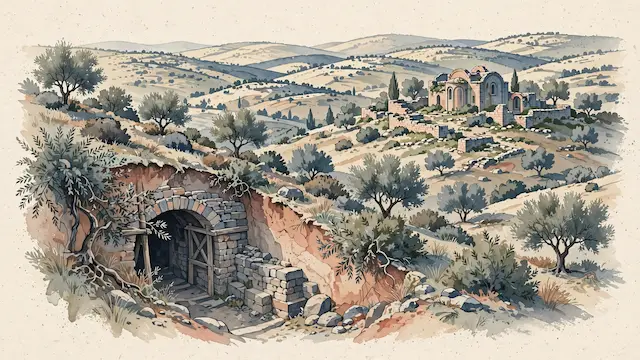
The archaeological site of Khirbet Burgin, located in the Adulam-France Park in Israel's Judean Foothills, has been reopened to the public following extensive preservation and development work by the Jewish National Fund (JNF) and the Israel Antiquities Authority (IAA). The site, which dates back nearly 2,000 years, features a complex network of tunnels used by Jewish residents during the Roman period, elaborate burial caves, and a Byzantine-era church with colorful mosaic floors.
Archaeological excavations at Khirbet Burgin, led by IAA archaeologists Dr. Amir Ganor, Alon Klein, and Dr. Peter Gendelman, have revealed a long settlement continuum from the Second Temple period to the Ottoman era. Initially a Jewish village, possibly identified with the village of Bish mentioned by historian Josephus, it later became a center for residential buildings, burial caves, and a Christian monastery. During the Roman period, residents carved extensive hideout systems into the rock, likely in preparation for conflict with the Romans, with the settlement suffering damage during the Bar Kokhba revolt.
Following the revolt, a pagan population settled the area, constructing new buildings and excavating elaborate burial systems. Centuries later, during the Byzantine period, a large church with mosaic floors and an adjacent monastery complex were built. The site also yielded evidence of agricultural life, including wine presses and columbaria for raising pigeons.
Dr. Amir Ganor noted that the site had suffered from antiquities looting over the years, with looters damaging burial caves and hideouts. He stated that enforcement actions by the IAA in cooperation with the JNF helped curb the damage, allowing for the preservation and public accessibility of the site. Recent work included preserving the Byzantine church's mosaics and reconstructing its outline to help visitors visualize the original structure.
Ami Shahar, Deputy Director for Preserving Built Heritage at the IAA, emphasized that the project aims to make the ancient remains an accessible cultural asset for future generations. The reopened site offers visitors a circular walking route of approximately 2.5 kilometers, taking two to three hours, which passes by burial caves, viewpoints, ancient building remains, wine presses, and hideout tunnels. The route includes the Cave of the Pillars, the House of Lamentation Cave, and the Bucranium Cave, featuring a stone relief of a bull's head. The summit offers panoramic views of the Judean Foothills. The JNF's Chairman, Eyal Osterinsky, stated that the JNF's responsibility includes protecting historical heritage and making it accessible to the public.
Mentioned
The same event, reported separately by each outlet. Open a few to compare what different newsrooms emphasize — and what they leave out.
Left 1Centre 3Right 3Haredi 1Other 1









Not the same event — other stories that share this one’s people, places, or theme: background, reactions, and follow-ups.
