
Israel Faces Budget Crisis: Tax Hikes or Spending Cuts Loom
Translated & summarized from Cursorinfo by baba
Israel's economy faces significant post-conflict costs, estimated at 405 billion shekels by 2026, due to increased defense spending and potential shifts in U.S. military aid. Despite resilient GDP growth projections, a widening budget deficit and rising national debt are forcing difficult choices. The government must decide between raising taxes, cutting civilian services, or increasing borrowing, impacting future generations.
The story in 6 lines · by baba
- Israel's economy faces an estimated 405 billion shekel ($130 billion) cost from recent conflicts through 2026.
- Defense spending has nearly doubled its share of GDP, reaching 8% by 2026.
- Budget deficit is projected at 4.4% in 2026 and national debt at 68% of GDP.
- Uncertainty looms over U.S. military aid beyond 2028, potentially costing $10 billion.
- Israel must choose between tax hikes, spending cuts, or increased borrowing to manage its budget.
- Despite challenges, GDP growth is projected at 4.5% for 2026, with higher forecasts from the Bank of Israel.
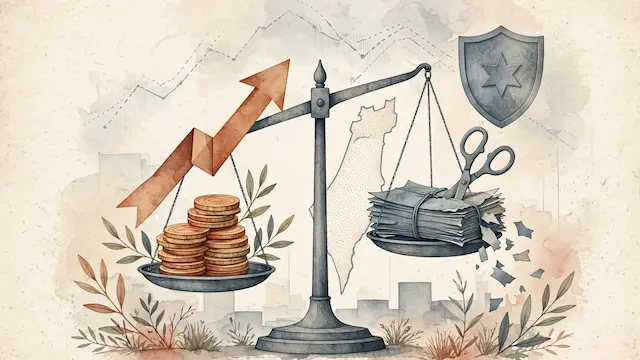
Israel's economy faces significant financial strain due to recent conflicts, with analysts estimating total direct and indirect costs between 2023 and 2026 at approximately 405 billion shekels (nearly $130 billion). This figure, which includes the impact of the late February 2026 conflict with Iran, surpasses previous Central Bank calculations. Despite the immense pressure, including reservist call-ups and logistical disruptions, the Israeli economy has shown resilience, avoiding a severe recession thanks to foreign currency reserves, a stable banking system, natural gas exports, and private sector activity. The International Monetary Fund projects Israel's GDP growth at 4.5% for 2026, while the Bank of Israel forecasts even higher figures of 5.6% for 2026 and 7.5% for 2027. However, these optimistic macroeconomic figures are largely driven by the overseas operations of Israeli corporations, with domestic market growth projected at a more modest 3.4% and 5.1% respectively.
The primary long-term challenge is a drastic shift in budget priorities towards the defense sector. Defense spending has surged from about 4.2% of GDP in 2022 to nearly 8% by 2026, consuming a quarter of all government expenditures, approximately 175 billion shekels. This increased allocation is necessary for replenishing arsenals, acquiring new equipment, and maintaining readiness on multiple fronts. This imbalance is leading to a growing budget deficit, projected at 4.4% of GDP in 2026 and 4.6% in 2027, with national debt expected to reach a critical 68% of GDP by the end of 2026. The rising debt incurs substantial servicing costs, diverting funds from essential civilian sectors like education, healthcare, and social welfare.
Adding to the financial authorities' concerns is the uncertainty surrounding U.S. military aid. While regular aid of about $7 billion is guaranteed for the next two years, the fate of larger contracts worth $10 billion after 2028 remains undecided. The potential shift to self-funding military procurement will force the defense establishment to compete for budget resources on equal footing for the first time in years. This situation presents the incoming government with a difficult choice: either implement unpopular tax increases for citizens and businesses, cut civilian investments in infrastructure and healthcare, or continue borrowing, burdening future generations with debt repayment.
Mentioned

