Israeli Stock Market Plummets Amid Election Uncertainty
Translated & summarized from Jüdische Allgemeine by baba
Israel's stock market experienced significant losses and increased volatility following Tuesday's parliamentary elections, as investor hopes for change were dashed by unclear results. The shekel weakened against the dollar, and key indices fell sharply, particularly affecting domestically focused companies. The CEO of the Tel Aviv Stock Exchange called for a broad government to prioritize economic stability, while Fitch Ratings affirmed Israel's 'A' credit rating with a negative outlook due to anticipated political uncertainty.
The story in 6 lines · by baba
- Israeli stock market indices fell sharply, erasing recent gains amid post-election political uncertainty.
- The local volatility index surged 30 percent, indicating a significant increase in market instability.
- The shekel weakened against the dollar as election results contradicted investor expectations for change.
- Tel Aviv Stock Exchange CEO Itai Ben-Zeev urged leaders to form a consensus government for economic stability.
- Fitch Ratings kept Israel's credit rating at 'A' with a negative outlook due to expected political uncertainty.
- Parties opposing PM Netanyahu secured 67 seats, while Netanyahu's bloc won 53 seats in the Knesset.
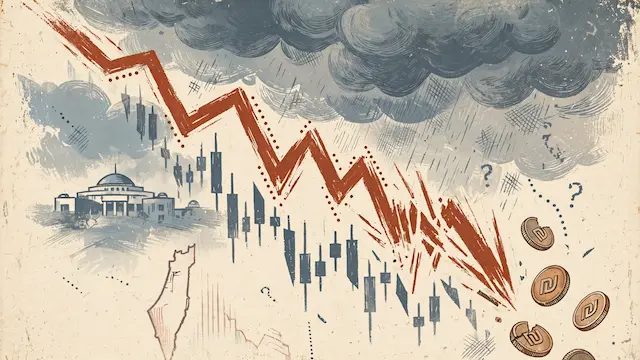
Israel's stock market experienced significant losses following the parliamentary elections held on Tuesday, reflecting the nation's political uncertainty. Key indices turned red, with some suffering their worst trading days in months or even years, erasing all gains accumulated since early October. Concurrently, the local volatility index, a measure of market stability, surged by 30 percent, and long-term government bonds also saw substantial declines.
Prior to the election, economic optimism had prevailed. On Monday, the Tel Aviv Stock Exchange rose nearly two percent, with analysts attributing this to investor hopes for change and a potential opposition victory, despite polls indicating an unclear outcome. This optimism extended to election day, with the shekel strengthening by two percent against the dollar early on, fueled by expectations that high voter turnout would benefit the opposition. However, as actual results emerged, this trend reversed, with the shekel losing value as it became clear that market expectations did not align with the election outcomes.
On Wednesday, the market faced further pressure. The TA-125 index dropped 2.5 percent and the TA-90 index fell 4.5 percent. Companies heavily reliant on the domestic economy were particularly hard hit, with the construction index plummeting 8.8 percent, insurance stocks down 5.2 percent, and bank shares off 4.9 percent. The dollar rose to 3.127 shekels from around 3.02 shekels the previous day, and the euro climbed to 3.48 against the Israeli currency.
In response to the heightened uncertainty, Itai Ben-Zeev, CEO of the Tel Aviv Stock Exchange, issued an open letter urging political leaders to prioritize Israel's economic future over partisan disputes and to form a broad, consensus-based government. He emphasized that national responsibility should supersede short-term political considerations and that a unified government does not require abandoning principles.
Meanwhile, rating agency Fitch maintained Israel's credit rating at 'A' with a negative outlook, warning of increased risk of prolonged political uncertainty and a transitional government following the elections. Fitch noted that Israel's "contentious" domestic political environment and the potential for a government lacking a clear majority are consistent with the current rating. The article also noted that parties opposing Prime Minister Benjamin Netanyahu collectively secured 67 seats, while Netanyahu's bloc, including right-wing and ultra-Orthodox parties, won 53 seats, suggesting that deep ideological divides and conflicting campaign promises will likely prolong the current uncertainty.
Mentioned
The same event, reported separately by each outlet. Open a few to compare what different newsrooms emphasize — and what they leave out.
Centre 1Arab 1

Not the same event — other stories that share this one’s people, places, or theme: background, reactions, and follow-ups.




