
Arab Parties' 19 Seats Force New Political Equation, Test Eisenkot
Translated & summarized from Arab48 by baba
Following Israeli Knesset elections, neither Benjamin Netanyahu's bloc nor Gadi Eisenkot's bloc secured a parliamentary majority, leaving the 19 seats won by Arab parties as a crucial factor. MK Maha Karkabi-Saba highlighted the historic achievement of high Arab voter turnout and warned against concessions to Eisenkot's bloc. The results present a challenge for Arab parties to translate their representation into influence and test Eisenkot's willingness to engage with the Arab community as a political partner.
The story in 5 lines · by baba
- Arab parties' 19 Knesset seats have become a decisive factor in forming Israel's next government.
- Neither Benjamin Netanyahu's nor Gadi Eisenkot's blocs secured a parliamentary majority in the recent elections.
- MK Maha Karkabi-Saba called the high Arab voter turnout a historic political achievement.
- Karkabi-Saba warned against compromising core principles when negotiating with Gadi Eisenkot's bloc.
- Gadi Eisenkot faces a test in deciding whether to engage with the Arab community as a political partner.
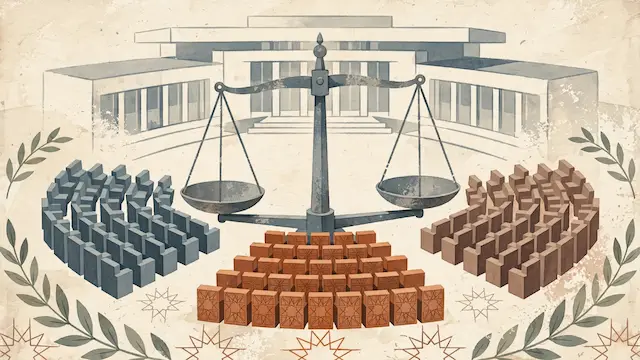
Israeli Knesset election results have intensified the political struggle, with no single bloc securing a parliamentary majority. Prime Minister Benjamin Netanyahu's bloc garnered 53 seats, while Gadi Eisenkot's bloc reached 48. The 19 seats won by the two Arab lists (the Joint List and the United List) have become a decisive factor in shaping the upcoming political phase, amidst conflicting coalition calculations and unprecedented polarization over the role of Arab parties in governance.
Despite a significant shift in power dynamics, forming an alternative government faces obstacles. Eisenkot insists on a "broad Zionist government" with principles regarding the state, conscription, and dismantling Hamas's military capabilities in Gaza, yet faces internal opposition to cooperating with Arab parties. Netanyahu, meanwhile, is struggling to regain the full parliamentary strength of his former partners.
The Arab community emerged as a key determinant after achieving record representation with 19 seats, driven by high voter turnout reflecting increased political mobilization. This success, however, presents Arab parties with the challenge of translating this representation into tangible influence.
MK Maha Karkabi-Saba of the Joint List described the high Arab voter turnout, nearing 80%, as a historic political achievement, reflecting the Arab community's awareness and rejection of recent political deterioration. She noted that the election results reduced the chances of figures like Itamar Ben-Gvir and Bezalel Smotrich returning to the next government, who were responsible for "the most dangerous policies and programs of the last government."
Karkabi-Saba emphasized that the election results delivered a message that Netanyahu, despite his responsibility for the Gaza war, settlement policies, and racist rhetoric, could not secure an easy majority. She warned against viewing Eisenkot's bloc as a guaranteed alternative, pointing out his right-wing stances on several issues and the presence of figures in his camp with settlement views or ideas about expelling Arab citizens. She stressed the need for caution and avoiding concessions on core principles while strategically aiming to prevent Netanyahu's return.
Karkabi-Saba stated that Eisenkot cannot form a government while completely ignoring the Arab community. If he is serious about leading the bloc against Netanyahu, he must decide whether to engage with Arab citizens as political partners or keep them on the political periphery. She added that transforming parliamentary representation into tangible change will be difficult due to internal obstacles within both Arab parties and Eisenkot's bloc, where some have explicitly refused to sit with or rely on Arab support. Eisenkot also faces challenges with alternative scenarios, including a national unity government or new elections, which she believes would primarily benefit Netanyahu.
Mentioned
The same event, reported separately by each outlet. Open a few to compare what different newsrooms emphasize — and what they leave out.
Centre 1Arab 1

Not the same event — other stories that share this one’s people, places, or theme: background, reactions, and follow-ups.


