
Haifa's Voter Turnout Rises But Lags Behind Major Cities
Translated & summarized from Maariv by baba
Voter turnout in Haifa increased to 62% in the 2026 elections, though it still trails other major Israeli cities. Professor Itai Bari's analysis reveals significant turnout and voting pattern disparities between Haifa's neighborhoods. Despite the rise, the overall political balance saw only minor shifts, but a hypothetical scenario shows Haifa's votes could dramatically alter Knesset composition.
The story in 5 lines · by baba
- Haifa's voter turnout rose to 62% in 2026, but still lags behind most major Israeli cities.
- Significant turnout and voting differences exist between Haifa's diverse neighborhoods.
- Socioeconomic status correlates with turnout, but other factors like age and community also influence voting.
- The overall political balance in Haifa shifted minimally despite increased participation.
- A hypothetical scenario suggests Haifa's votes alone could significantly change Knesset composition.
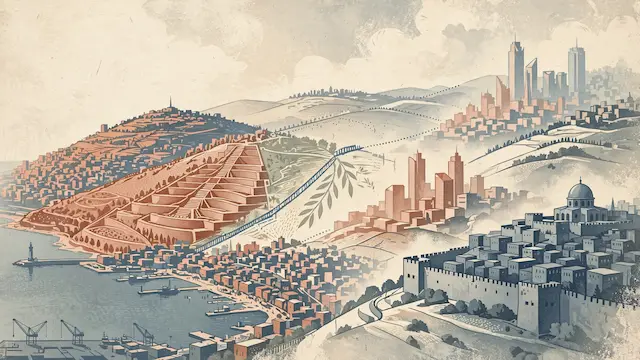
Voter turnout in Haifa saw a significant increase in the 2026 elections, reaching approximately 62%, up from 55.5% in 2022. Despite this surge, the city still lags behind most major Israeli metropolises, with national turnout nearing 78%. Professor Itai Bari from the University of Haifa analyzed the voting patterns, noting that the increase was widespread across all eight examined districts, with some areas like Neve Sha'anan and Yizre'elia seeing an eight-percentage-point rise.
However, substantial disparities persist between Haifa's neighborhoods. Turnout in affluent areas like Ramot Carmel reached about 71%, while lower-income areas such as Hadar saw only 53% participation, and the Lower City recorded a mere 49%. These differences reflect varied political and social realities within the city. For instance, the "Change Bloc" garnered 77% of votes in Ramot Carmel, while right-wing and Religious Zionist parties received 46% in Kiryat Haim and Kiryat Shmuel, and Arab parties dominated the Lower City with 59% of the vote.
Bari's analysis also highlights a strong correlation between a district's socioeconomic status and voter turnout, with wealthier areas generally showing higher participation and greater support for the Change Bloc. However, he cautions that economic status and education alone do not fully explain voting behavior, with age, religion, ethnicity, and community cohesion also playing roles. In tightly-knit communities, voting can become a social norm, whereas anonymity in larger cities may weaken this effect.
While turnout increased, the overall political balance in Haifa shifted only slightly. The Change Bloc's support rose from 54% in 2022 to 55% in 2026, adding about 15,000 votes. Right-wing and Religious Zionist parties saw their vote share decrease from 27% to 24%, while Arab parties gained from 9% to 11%, and ultra-Orthodox parties dropped from 7% to 5%.
Bari conducted a thought experiment to illustrate Haifa's unique political impact: if all 120 Knesset members were elected solely based on Haifa's results, the composition of parliament would change significantly. In a scenario where the electoral threshold was based on Haifa's votes, only seven lists would enter the Knesset. Under a second scenario, where the national threshold applied but seat allocation was based on Haifa's votes, the Change Bloc would secure 70 seats, right-wing parties 30, Arab parties 14, and ultra-Orthodox parties six. This hypothetical demonstrates how Haifa's voting patterns could alter national political outcomes.
Historically known as "Red Haifa" due to its labor movement roots, the city's political landscape has evolved. The current "Change Bloc" includes centrist and left-wing parties, alongside figures with right-wing backgrounds. Simultaneously, right-wing parties have gained significant support in various areas, and Arab and ultra-Orthodox populations are no longer concentrated in single urban enclaves. Bari concludes that the city's political identity is now shaped more by evolving political traditions, community identities, and social characteristics than by strict party loyalty.
Mentioned


