
Turkish Intelligence Report Names Israel Strategic Rival, Sees Syria as Flashpoint
Translated & summarized from Maariv by baba
A Turkish intelligence report identifies Israel as a long-term strategic rival, asserting that this view is deeply ingrained and will persist regardless of Israeli leadership changes. The report highlights Syria as the most dangerous flashpoint due to conflicting interests, with the rivalry also extending to the Eastern Mediterranean and trade routes. Turkey is advised to strengthen regional ties rather than engage in direct military confrontation. The analysis suggests that the strategic differences between the two nations are profound and likely to continue shaping their relationship.
The story in 5 lines · by baba
- Turkish intelligence labels Israel a strategic rival, predicting this stance will persist beyond current leadership.
- Syria is identified as the most dangerous arena for potential conflict between Turkey and Israel.
- The rivalry extends to the Eastern Mediterranean and trade routes, impacting regional alliances and energy projects.
- Turkey is advised to focus on regional diplomacy and alternative trade routes instead of direct military action.
- The report suggests a change in Israeli leadership will not fundamentally alter its foreign and security policy.
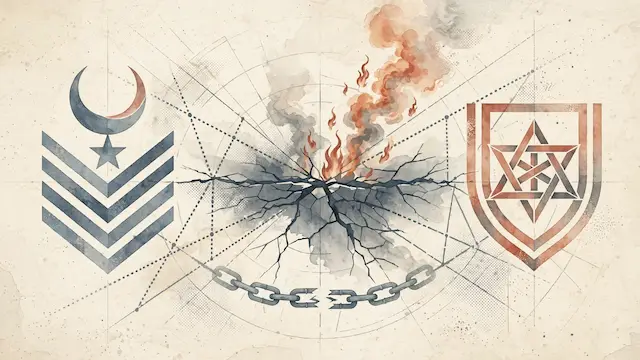
A recent analysis based on a Turkish intelligence report designates Israel as a long-term strategic rival to Turkey, suggesting that this perception is deeply rooted and unlikely to change significantly even with a potential change in Israeli leadership. The report, published by the Turkish National Intelligence Academy (MIA) under the Turkish Intelligence Organization (MİT) on October 23, is titled "The Anatomy of Israeli Expansionism." It posits that Israeli regional policy is not a temporary phenomenon tied to a specific government but a profound trend that will persist.
The analysis, released shortly after Israel's 26th Knesset elections, suggests that the identity of Israel's next prime minister will not fundamentally alter its foreign and security policy. While acknowledging stylistic differences between potential leaders like Benjamin Netanyahu and Gadi Eisenkot, the report argues that core strategic views regarding Iran, Syria, and Lebanon are likely to remain consistent. Eisenkot's past roles as commander of the Northern Command, IDF Chief of Staff, and his involvement in Netanyahu's war cabinet are cited as reasons for this assessment.
Syria is identified as the most dangerous arena for potential conflict between Turkey and Israel. The Turkish report suggests that Turkey favors strong central governments in neighboring countries, while Israel prefers weaker, fragmented states to maintain operational freedom. This divergence is particularly evident in Syria, where Ankara seeks to bolster the Damascus regime and expand its influence, while Israel aims to secure its interests and prevent threats from establishing themselves.
The rivalry extends beyond Syria to the Eastern Mediterranean and Cyprus, areas of growing strategic importance due to regional alliances, security cooperation, and energy projects. Turkey views Israel's expanding ties with Greece and Cyprus as part of a regional framework that could limit Turkish maneuverability. Economically, Turkey also sees the India-Middle East-Europe Economic Corridor (IMEC) as a potential competitor to its own trade and transportation initiatives, prompting Ankara to promote alternative routes.
The report advises Turkey to avoid direct military responses to Israeli actions and instead focus on strengthening regional ties, supporting stable governance in neighboring countries, and developing alternatives to regional arrangements that exclude it. While acknowledging that some commercial and security ties between Turkey and Israel have persisted despite crises, the analysis concludes that the underlying strategic disparities are likely to continue to shape their relationship, with Syria remaining a central point of friction. The potential for de-escalation may depend significantly on ongoing American involvement.