
Election Results Reveal Israel's Complex Political Reality
Translated & summarized from Davar by baba
Recent Israeli election results revealed a deeply divided nation, with Prime Minister Benjamin Netanyahu remaining a dominant political force despite criticism. The article argues that the election outcomes present a hard reality, challenging media narratives and highlighting the complexity of forming a stable government. It suggests that a national unity government, or 'ceasefire government,' is the only viable option for political stability, despite its limitations and the reluctance of major parties.
The story in 6 lines · by baba
- Election results show Benjamin Netanyahu remains Israel's most popular politician, despite criticism.
- The article contrasts election predictions with the 'hard reality' of voter choices.
- Significant Arab voter turnout is highlighted as a key democratic moment.
- Forming a stable government is complicated by the ongoing conflict and political stances.
- A national unity government is presented as the only path to current stability.
- The 'Anyone But Bibi' political movement is considered defunct.
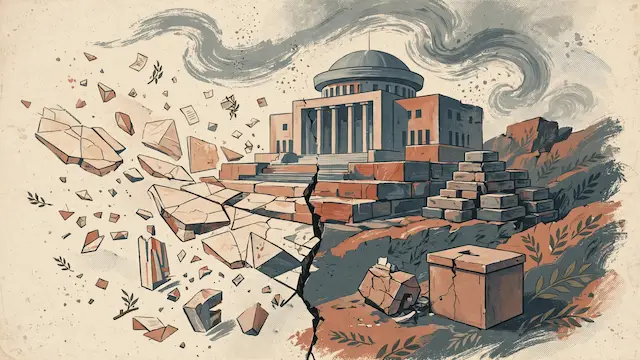
Recent election results in Israel have underscored the nation's complex and often contradictory political landscape, challenging pre-election predictions and media narratives, much like a famous Saturday Night Live sketch depicting the 2016 U.S. presidential election.
The article draws a parallel to the SNL sketch where liberal youth were shocked by Donald Trump's victory, contrasting their expectations with the actual vote. Similarly, Israelis have discovered that a significant portion of the population continues to support Prime Minister Benjamin Netanyahu and the Likud party, even after the October 7th events and judicial reforms. Conversely, a substantial segment of the electorate strongly desires a change in leadership.
The author emphasizes that election results, representing the physical act of voting by individuals, reveal the 'true results' and a 'hard reality' that supersedes polls, media discourse, or academic analysis. The article notes the significant turnout of Arab citizens as a crucial democratic moment, especially in light of policies by ministers like Itamar Ben-Gvir and May Golan, which the author claims have negatively impacted the lives of Arab Israelis.
Despite the potential for a change government supported by Arab parties, the article highlights significant obstacles. The ongoing military conflict and the political stances of Arab parties, particularly the Joint List's opposition to the war and accusations against Israel, make their inclusion in a governing coalition problematic. While Ra'am's leader, Abbas, has shown flexibility, the current political climate makes a stable coalition dependent on Arab parties uncertain and potentially detrimental to national security considerations.
The piece argues that Netanyahu remains the most popular politician in Israel, attributing this to various factors including voter satisfaction with his policies, despite his responsibility for the October 7th failures and his alleged obstruction of investigations. The 'Anyone But Bibi' (RLB) movement is deemed politically defunct, unable to form a stable government without him. The author suggests that the current political blocs are largely stable, making it difficult for any single faction to form a government with broad public legitimacy.
Ultimately, the article posits that the only path to political and social stability in Israel currently lies in a national unity government, or a 'ceasefire government.' While no major political faction desires this, the author contends it is a necessary, albeit limited, solution to manage the political deadlock. Such a government would focus on core security responsibilities and basic governance, aiming to de-escalate internal conflict rather than enacting sweeping reforms. The author acknowledges the many unresolved political questions, such as the October 7th investigation and Netanyahu's trial, but stresses the lack of viable alternatives.
Mentioned
The same event, reported separately by each outlet. Open a few to compare what different newsrooms emphasize — and what they leave out.
Left 2

Not the same event — other stories that share this one’s people, places, or theme: background, reactions, and follow-ups.



