
Israel's Next Government Faces Nine Urgent Housing Challenges
Translated & summarized from Globes by baba
Israel's next government faces nine major housing challenges, including the ineffective land marketing by the Israel Land Authority, lengthy delays in housing lotteries, and an oversupply of planned units. Issues with public transportation, strained local authorities, a struggling rental market, and difficulties implementing property taxes also require attention. Key leadership positions in planning authorities remain unfilled, hindering progress. The article argues for a complete overhaul of housing policy, moving away from the failed strategies of former Finance Minister Moshe Kahlon, which failed to lower prices and instead saw them rise significantly.
The story in 7 lines · by baba
- Israel's next government must address nine critical housing challenges, including land authority failures and lottery delays.
- Housing lotteries have led to five-year waits for recipients and failed to lower prices.
- Over-planning has created a surplus of approved housing units, impacting urban renewal viability.
- Public transportation infrastructure is inadequate, limiting housing options and increasing commute times.
- Local authorities are burdened by rapid growth without sufficient economic support.
- The long-term rental market is dominated by private investors, with limited corporate involvement.
- Key planning positions remain vacant, hindering crucial decision-making processes.
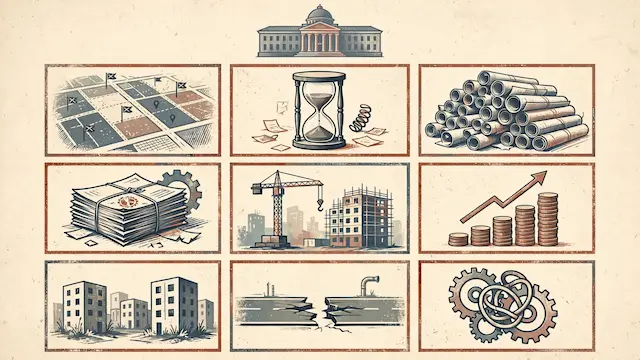
The incoming Israeli government will confront nine critical challenges in the housing sector, requiring immediate and transformative solutions. A significant issue is the weak performance of the Israel Land Authority (ILA) in marketing land for housing. This is partly attributed to the controversial appointment of Yehuda Eliyahu, a confidant of Smotrich, as interim director, despite lacking relevant experience. The ILA's focus on marketing land in convenient locations rather than where it's most needed, exemplified by the controversial sale of the Shevach Dov lands without prior pollution checks, has hampered progress. Furthermore, the ILA has largely neglected the crucial task of identifying complementary land reserves for urban renewal projects, particularly in peripheral areas.
Another major challenge lies with government housing lotteries, which have failed to lower prices and have significantly increased waiting times for recipients. While discounts may have grown, the number of available apartments has shrunk, and winners now face waits of five years or more for occupancy. This extended delay stems from lotteries being held for land that is not yet ready for planning or infrastructure development. The government's perception of lotteries as a populist measure, rather than a flawed process, exacerbates the problem, leading to financial strain on first-time buyers who must pay rent and mortgages simultaneously.
The planning system also presents a hurdle, with the approval of approximately 1.5 million housing units over the past decade, double the number of units construction began on. This over-planning, often on agricultural land, has reduced the economic viability of urban renewal projects, which are inherently slower and more complex. The next government must decide the future of the National Planning and Building Council (VATMAL) and determine whether planning should be centralized or devolved to local authorities.
Public transportation remains a critical, yet under-addressed, factor. Despite past recognition of its importance, improvements have been minimal, exacerbating housing limitations by making distant locations impractical for commuting. The construction of thousands of apartments in peripheral cities without corresponding job growth has led to a daily influx of commuters to central employment hubs, straining infrastructure.
Local authorities also face significant strain. While government initiatives like "umbrella agreements" aim to provide infrastructure for new neighborhoods, they often fall short of covering the ongoing operational and maintenance costs, placing a heavy burden on municipalities. The rapid growth of some cities has outpaced their planning and economic capacity.
The rental market is another area of concern, with long-term rentals by private companies and REITs accounting for only about 4% of the market. The government's efforts through "Dirah Le'Haskir" have proven largely ineffective. The article also questions the actual contribution of real estate investors to rising prices and the effectiveness of current taxation policies.
Finally, the implementation of a property tax, proposed at 1.5% on vacant land, faces significant practical difficulties and has historically been difficult to enforce. Additionally, several key positions within planning authorities remain vacant due to the absence of a permanent Interior Minister, hindering crucial appointments and decision-making processes. The article concludes by emphasizing the need for a fundamental rethinking of housing policy, moving beyond the largely unsuccessful approach of former Finance Minister Moshe Kahlon, which saw housing prices increase by over 60% during its tenure.
Mentioned


