
Dollar Falls Against Shekel Amid Election Result Speculation
Translated & summarized from Arab48 by baba
The U.S. dollar fell by about 2% against the Israeli shekel to around 3.04 shekels on Tuesday, coinciding with Israeli elections. This local strength contrasts with the dollar's global rise and is attributed to investor expectations about election results, capital inflows, and hedging. The shekel's future performance depends on election outcomes, government stability, U.S. interest rates, and security. The strengthening shekel negatively impacts exporters but may benefit importers and consumers.
The story in 5 lines · by baba
- The U.S. dollar fell approximately 2% against the Israeli shekel to around 3.04 shekels on Tuesday.
- The shekel's appreciation is linked to investor expectations about Israeli election results and capital inflows.
- The dollar's movement is influenced by election outcomes, government stability, and U.S. monetary policy.
- Exporters are negatively affected by the strengthening shekel, while importers may benefit.
- The Bank of Israel can intervene in the currency market to manage shekel appreciation.
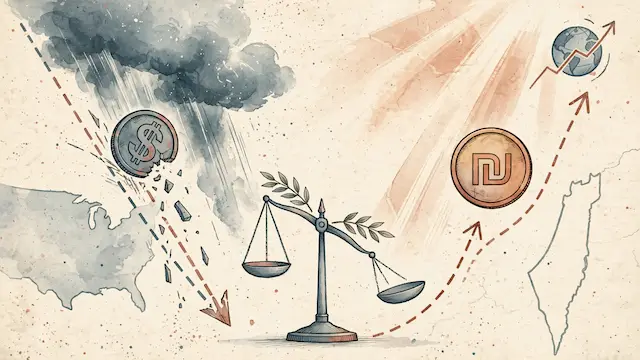
The U.S. dollar depreciated by approximately 2% against the Israeli shekel on Tuesday, reaching around 3.04 shekels during continuous trading. This decline occurred concurrently with Israeli elections, despite the dollar's global rise. Analysts attribute the shekel's strength to investor expectations regarding the election outcomes, alongside capital inflows and hedging activities by financial institutions. The dollar's future movement will depend on the election results, the nature of the next government, U.S. interest rate decisions, security developments, and investment flows. The Bank of Israel officially set the dollar's rate at 3.078 shekels, a 1.09% decrease, before it fell further to approximately 3.04 shekels in ongoing trading. The euro also declined, with its official rate set at 3.4462 shekels, falling 1.1% to about 3.39 shekels in continuous trading. The dollar's drop against the shekel contrasts with its global performance, where the dollar index rose 0.25%. This suggests local factors, primarily the Israeli elections, are driving the shekel's appreciation. Investors anticipate that reduced political uncertainty or the formation of a stable government could lower risks for Israeli assets and boost foreign investment, increasing demand for the shekel. Conversely, election results leading to prolonged political crises, government formation difficulties, or the continuation of a government perceived by investors as increasing institutional and security risks could lead to renewed dollar demand. Market participants are also awaiting the U.S. Federal Reserve's interest rate decision, with expectations of rates remaining between 3.75% and 4%. Israel's current interest rate is 3.25%, meaning the interest rate differential still favors the dollar, making its decline against the shekel notable and highlighting the impact of local factors. Hedging operations by Israeli financial institutions also play a role. When foreign stocks rise, investment portfolios' dollar exposure increases, prompting institutions to sell dollars. Conversely, sharp drops on Wall Street might lead these institutions to buy dollars. Foreign investment in Israel's high-tech sector and the liquidation of employee stock options contribute to increased dollar supply in the local market. The strengthening shekel has mixed economic effects. Exporting companies receiving revenue in dollars and paying expenses in shekels are negatively impacted. For example, a software company earning $1 million monthly could lose about 30,000 shekels in revenue value if the dollar falls from 3.07 to 3.04 shekels. Importers and consumers may benefit from lower costs for foreign goods and travel, though bank currency conversion margins might reduce this effect. Lower dollar values also decrease the shekel-denominated returns for Israeli investors holding dollar assets. The Bank of Israel can intervene by buying dollars to curb shekel appreciation and protect exports, but intervention is not automatic and may be limited by large financial flows or risk perception changes. With Israeli inflation at 1.6% and the interest rate stable at 3.25%, the central bank can monitor developments without immediate monetary policy adjustments.
The same event, reported separately by each outlet. Open a few to compare what different newsrooms emphasize — and what they leave out.
Arab 1Other 1

Not the same event — other stories that share this one’s people, places, or theme: background, reactions, and follow-ups.




