
Dollar Falls Sharply Against Shekel Despite Global Rise
Translated & summarized from i24NEWS Arabic by baba
The U.S. dollar has fallen sharply against the Israeli shekel, dropping 1.1% to around 3.04 shekels, despite a global rise in dollar strength. This local decline is attributed to factors including upcoming Israeli elections, institutional investor hedging, and foreign investment in the tech sector. While the depreciation benefits importers and consumers, it reduces export revenues and returns on dollar assets for Israelis. The Bank of Israel can intervene but its capacity may be limited by large capital flows.
The story in 5 lines · by baba
- The U.S. dollar fell 1.1% against the Israeli shekel to near 3.04, defying global dollar strength.
- Upcoming Israeli elections are a key factor influencing investor sentiment and capital flows.
- Institutional investors' hedging activities and foreign tech investments increase dollar supply in Israel.
- Dollar depreciation benefits Israeli importers and consumers but hurts exporters.
- The Bank of Israel can intervene but its ability is limited by market forces.
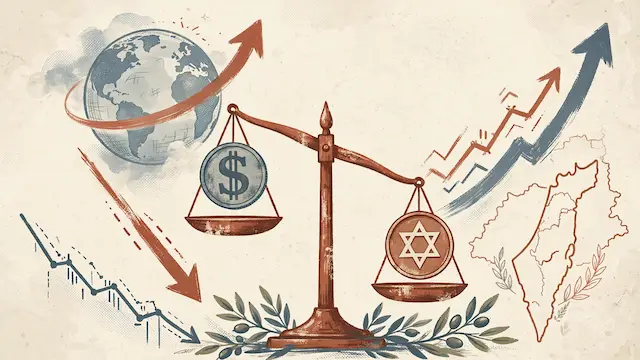
The U.S. dollar has experienced a significant decline against the Israeli shekel, trading near 3.04 shekels, a drop of about 1.1% from its previous rate. This comes even as the dollar index (DXY) has risen globally to approximately 102.2 points, indicating dollar strength against other major currencies. The divergence suggests that local Israeli factors are currently exerting more influence on the shekel's exchange rate than global trends.
Israeli elections are a key factor being closely watched by investors. A reduction in political uncertainty, if election results are perceived to lead to greater stability, could lower risk premiums on Israeli assets and attract capital inflows. This might prompt foreign investors to sell dollars and buy shekels, boosting the Israeli currency. Conversely, political deadlock or a government perceived as increasing security or institutional risks could lead investors to seek the dollar as a relative safe haven.
Market participants are also awaiting the U.S. Federal Reserve's next interest rate decision, with expectations of rates remaining between 3.75% and 4%. Israel's current interest rate is 3.25%, creating an interest rate differential favoring the dollar. Despite this, the dollar's decline against the shekel highlights the impact of local factors and capital flows.
Institutional investors' hedging activities also contribute to market volatility. When global stock markets rise, these institutions may increase their dollar-denominated assets, leading them to sell dollars to rebalance their portfolios. Conversely, sharp drops in U.S. markets might prompt them to buy dollars. Foreign investment in Israel's tech sector, along with employees selling stock options, also increases the dollar supply in the local market.
The dollar's depreciation benefits importers and consumers by lowering the cost of dollar-denominated goods and services, and making foreign expenses like travel cheaper in shekels. However, it reduces the value of export revenues for Israeli companies earning in dollars. For Israeli investors holding dollar-denominated assets, the decline reduces returns when calculated in shekels.
While the Bank of Israel can intervene in the foreign exchange market, it does not do so automatically. Intervention might be considered if the shekel's rapid strengthening negatively impacts exports or local market conditions. However, the central bank's intervention capacity may be limited if currency movements are driven by substantial capital flows or shifts in investor risk perception regarding the Israeli economy. The current inflation rate in Israel is 1.6% with an interest rate of 3.25%. These factors provide context for monetary policy but do not guarantee a policy change based on a single exchange rate movement. The shekel's rise may reflect improved investor sentiment towards Israeli assets, but future dollar-shekel movements will depend on the Federal Reserve's decisions, security developments, and the political and economic ramifications of the elections.




