
United Torah Judaism Instructs Poll Workers to Report Voter Turnout Despite Court Ban
Translated & summarized from Haaretz by baba
The United Torah Judaism party has directed its poll workers to report real-time voter turnout figures, despite a Supreme Court ruling prohibiting such disclosures. The party distributed instructions on how to count and report voter numbers, while also noting a Supreme Court ban on transmitting this information. The court's decision aimed to prevent the compromise of election integrity and enforcement of voter privacy rules.
The story in 5 lines · by baba
- United Torah Judaism instructed poll workers to report real-time voter turnout figures.
- The Supreme Court previously banned poll workers and observers from transmitting voter turnout data.
- The party distributed update sheets on how to count and report voter numbers.
- An advertisement urged voters to report that they had voted via a dedicated phone line.
- The court's ruling aimed to protect election integrity and voter privacy.
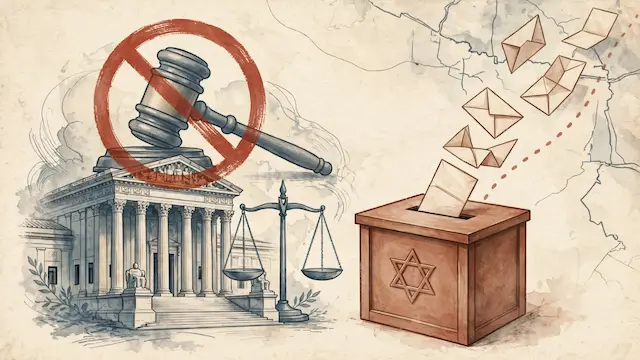
The United Torah Judaism party has instructed its poll workers to provide real-time updates on voter turnout, a directive that directly contradicts a Supreme Court ruling issued earlier this week. The party distributed update sheets to its poll workers detailing how to transmit these real-time reports, citing instructions from the Central Elections Committee that permit reporting voter numbers. These sheets specified that poll workers should mark each voter, whether they are on the main registry or using an outer envelope, and circle the total count and the time at each reporting interval. Workers were explicitly told not to use digital devices inside the polling station but to step outside to call a dedicated number. They were also instructed to report only the total number of voters, not their serial numbers, and to make calls from outside the polling station, adhering to election committee guidelines against phone use within the station.
However, the instructions also noted that poll workers are permitted to count voters and report the total number periodically, without any additional or identifying information. Meanwhile, an advertisement published in the newspaper "HaMevaser," associated with MK Meir Porush, urged voters themselves to report that they had voted via a dedicated phone line. The Supreme Court's decision on Sunday prohibited poll workers and party observers from transmitting information about the number of actual voters to their parties, with the ban applying universally to all methods of data transfer. This ruling followed a previous Supreme Court decision that overturned an attempt by Din Livne, acting Director-General of the Central Elections Committee, to allow party representatives to report voter numbers digitally. During the hearing for that petition, Justice Kabub sharply criticized Livne, stating that permitting phone reporting undermined the decision by the Chairman of the Central Elections Committee, Justice Noam Sohlberg, who had previously banned the transmission of voter identity details in real-time to prevent compromising enforcement of the prohibition.
Mentioned
The same event, reported separately by each outlet. Open a few to compare what different newsrooms emphasize — and what they leave out.
Left 1Centre 1

Not the same event — other stories that share this one’s people, places, or theme: background, reactions, and follow-ups.


