
Israeli Egg Prices Rise Amidst Global Declines, Raising Fairness Questions
Translated & summarized from Maariv by baba
Egg prices in Israel are set to rise by 30 agorot per carton to NIS 14.54 on November 1st, while U.S. egg prices have fallen significantly. This divergence is attributed to Israel's state-controlled market, which ensures stability but raises questions about fair pricing. A 2022 reform to increase competition was reportedly delayed, maintaining reliance on imports and controlled prices. Consumers are advised to compare prices across retailers as the regulated price is a ceiling, not a mandatory price.
The story in 5 lines · by baba
- Israeli egg prices will increase by 30 agorot to NIS 14.54 on November 1st.
- U.S. egg prices have fallen by about 64% from their March 2025 peak.
- Israel's state-controlled pricing mechanism is blamed for the price difference.
- A 2022 reform to deregulate the egg industry was reportedly delayed by a decade.
- Consumers are advised to compare prices between different supermarket chains.
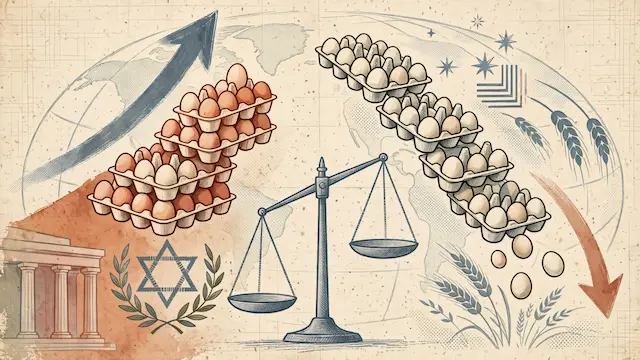
A carton of L-sized eggs in Israel will increase by 30 agorot to NIS 14.54 on November 1st. This modest price hike contrasts sharply with the situation in the United States, where the average price for a dozen eggs in September 2026 had fallen by approximately 64% from its March 2025 peak to $2.27. The disparity is attributed not to chicken conditions but to market structure, specifically Israel's state-controlled pricing mechanism.
Since 2023, an automatic mechanism determines egg prices quarterly, without requiring ministerial signatures. Prices are adjusted if cumulative changes exceed 3% over six months or 1% over a year. The current adjustment, occurring exactly one year after the previous one, suggests a gradual cost increase rather than a sharp, short-term pressure. While this system aims to ensure stability and fair prices for local producers, particularly in border areas, and bolster food security, its effectiveness in guaranteeing genuinely fair prices is questioned.
The article highlights that the state's control over production quotas limits supply expansion, leading to reliance on duty-free imports to meet peak demand, especially around holidays. A reform approved in 2022 to deregulate the industry and encourage competition was reportedly postponed for a decade due to political pressure.
While the regulated price in Israel protects consumers from the sharp price shocks seen in the U.S. due to factors like avian flu, it comes at a consistent cost. The article suggests that the impact of the current increase, though small for average families, will be more noticeable for larger households and small businesses. Transparency is called for, with a demand for the Ministry of Agriculture to publish detailed calculations behind the price adjustments, including feed costs and import volumes, to allow public scrutiny of the pricing formula.



