
Why October 7 Did Not Reshape Israel's Political Landscape
Translated & summarized from Davar by baba
Despite expectations that the October 7th attacks would reshape Israel's political landscape, upcoming elections show little change, with polarization intensifying. Experts like Amihai Danino, Poli Bronshtein, and Yedidia Stern attribute this to a global trend of deepening political divides and the public's preference for narratives confirming existing beliefs. While societal divisions persist, there's a hope that Israel could emerge as a leader in overcoming polarization through strong leadership and a renewed focus on national unity.
The story in 5 lines · by baba
- Israel's political map remains largely unchanged despite expectations following the October 7th attacks.
- Experts cite a global trend of escalating polarization and the public's preference for confirming narratives.
- The political center has vanished globally and in Israel, with divisions intensifying.
- Prime Minister Netanyahu's security strategy and narrative control are seen as key factors.
- There is concern that without a strong center, extremist factions could gain more power.
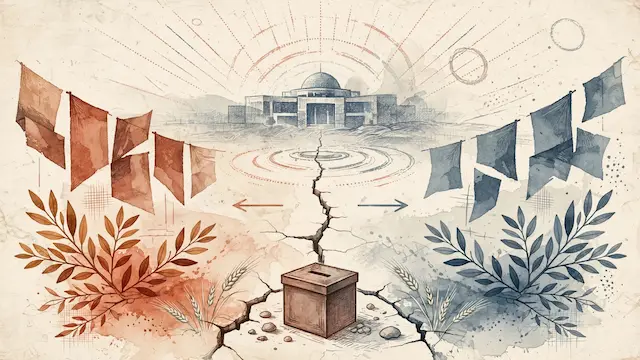
Despite widespread expectations that the trauma of October 7 would forge a new Israeli identity and heal political divisions, the country's political map remains largely unchanged heading into the upcoming elections. No significant new political forces have emerged, and the polarization between blocs has intensified. Three experts, Amihai Danino, Poli Bronshtein, and Yedidia Stern, discuss why the anticipated "political big bang" did not occur.
Amihai Danino, a research fellow and author, argues that while October 7 did not create new parties, it redefined the discourse. He notes Prime Minister Netanyahu's shift to a more proactive security strategy since the war began, a stance largely echoed by the opposition, who focus on executing Netanyahu's war aims more effectively rather than challenging his decisions. Danino suggests the "change bloc" has focused on internal societal reforms, which Netanyahu does not prioritize, believing Israel's strength lies in its economic and technological power, even at the expense of social cohesion.
Poli Bronshtein, CEO of the Century Initiative, agrees that the post-October 7 period offered a fleeting hope for change, but this was quickly overshadowed by a global trend of escalating polarization. She points to events in France and the US as examples of this worldwide phenomenon, where liberal democracies are struggling with deep divisions. Bronshtein believes that in this climate, the public is more receptive to narratives that confirm existing beliefs, making it difficult for new ideas or calls for unity to gain traction. She expresses concern that without a strong center, extremist factions could gain more power.
Yedidia Stern, President of the Jewish People Policy Institute, observes that the political center has indeed vanished globally and in Israel. He attributes the persistence of established political parties, particularly on the right, to Netanyahu's ability to shape narratives and deflect blame. Stern notes that while October 7 may have fostered a temporary sense of shared vulnerability, societal divisions have reasserted themselves, with political camps returning to their pre-war identities. He argues that the current political system prioritizes zero-sum outcomes over consensus-building, a global trend exacerbated by economic inequality and social media algorithms that amplify conflict.
All three experts suggest that while the immediate political landscape has not dramatically shifted, the long-term implications of October 7 are still unfolding. They highlight the global context of democratic crises and the resurgence of nationalism and antisemitism. While acknowledging the challenges, they also point to Israel's potential to forge a new path, emphasizing the need for leadership that can bridge divides and foster a shared national identity, potentially even leading the way in overcoming global polarization.
Mentioned

