
IDF Operation in Hebron Sparks Controversy Over Evacuations
Translated & summarized from Ynet by baba
The IDF launched a major operation in Hebron, arresting 10 suspects and focusing on neighborhoods linked to Hamas after two soldiers were killed. Residents were ordered to evacuate their homes "until further notice," sparking accusations of collective punishment from the Palestinian Authority and criticism from local officials. The operation, which involved special forces and intelligence, has led to the closure of schools and calls for international intervention to halt the actions.
The story in 6 lines · by baba
- IDF arrested 10 suspects in Hebron following an attack that killed two soldiers.
- Residents were ordered to evacuate homes in specific Hebron neighborhoods "until further notice."
- Palestinian Authority calls the IDF operation "collective punishment."
- Hebron Mayor links the operation to upcoming elections and calls it disproportionate.
- Schools in Hebron canceled classes due to the ongoing military operation.
- The operation followed a deadly shooting attack at the Yehuda junction.
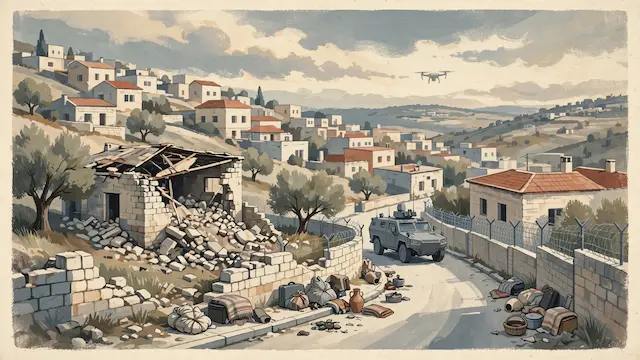
The Israel Defense Forces (IDF) conducted a large-scale operation in Hebron on Friday and Saturday, arresting 10 suspects following a deadly attack that claimed the lives of two soldiers, Ron Yonatan Reutman and Yuval Shai Suilam. The operation, codenamed "Roar of Judah," is concentrated in the Deir Baha and Al-Jaladah neighborhoods, areas believed to be associated with the Jabaa clan, which the IDF suspects is linked to Hamas and includes the perpetrators of the recent attack. The IDF stated that residents wishing to leave the operation zone were permitted to do so via designated checkpoints manned by the Shin Bet and IDF.
However, the operation has drawn significant criticism. Residents like Majdi Nasser reported being told to evacuate their homes "until further notice" by soldiers, with Nasser asserting his non-involvement with the clan and refusing to leave. Hebron Mayor Yosef al-Jaabari linked the operation to upcoming elections, suggesting it was a move by Prime Minister Netanyahu and his government to gain votes from settlers. He also claimed the IDF destroyed shops, factories, and roads, deeming the response disproportionate.
The Palestinian Authority has labeled the actions "collective punishment," with Governor of Hebron Khaled Dudin convening emergency meetings to address the impact on affected families. A joint emergency committee was formed to assess needs and coordinate aid. Deputy Chairman of the Palestinian Authority Hussein al-Sheikh, Prime Minister Mohammad Mustafa, and Head of General Intelligence Majed Faraj have pledged to continue international efforts to halt the operation.
Residents described the evacuation process as abrupt, with some needing assistance to leave due to age or illness. Hijazi al-Tamimi, a 70-year-old shop owner, recounted being woken by soldiers and given little time to pack. His 90-year-old mother-in-law, who is ill, had to be carried out. Khaled al-Tamimi, 68, expressed surprise that the attackers came from his neighborhood, which he characterized as law-abiding, questioning why he should be displaced and suggesting the Israeli government should punish the perpetrators directly.
Educational institutions in Hebron announced the cancellation of classes for Sunday and Monday, with a resumption contingent on developments. The operation began after the attack at the Yehuda junction near Hebron, where two Palestinian assailants opened fire on an IDF force, resulting in the deaths of the two soldiers and injuries to three others. The assailants were subsequently neutralized by additional forces.
Mentioned
The same event, reported separately by each outlet. Open a few to compare what different newsrooms emphasize — and what they leave out.
Left 1Centre 2Arab 1Other 1





Not the same event — other stories that share this one’s people, places, or theme: background, reactions, and follow-ups.



