
Israeli Military Operation in Hebron Displaces 1200 Palestinians
Translated & summarized from Panet by baba
The Israeli military displaced around 1,200 Palestinians in Hebron, West Bank, during an operation that began Saturday. The operation followed a Palestinian attack that killed two Israeli soldiers. The Israeli military stated the goal was to find militants and weapons, while the Palestinian Authority called it "collective punishment." The mayor of Hebron reported additional displacement risks and suggested the operation was politically motivated ahead of elections. Israel also imposed widespread closures across the West Bank.
The story in 6 lines · by baba
- Israeli military operation in Hebron displaced approximately 1,200 Palestinians.
- The operation began Saturday following a Palestinian attack that killed two Israeli soldiers.
- The Israeli military stated the operation aimed to search for militants and weapons.
- The Palestinian Authority condemned the operation as "collective punishment."
- Hebron's mayor suggested the operation was politically motivated by upcoming elections.
- Israel imposed widespread closures across the West Bank, restricting Palestinian movement.
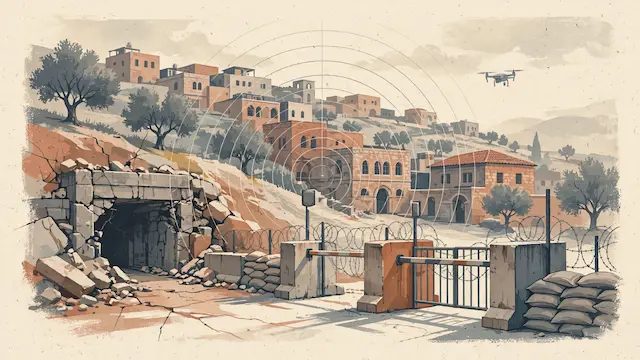
An Israeli military operation in the occupied West Bank city of Hebron has led to the displacement of approximately 1,200 Palestinians, according to a Palestinian official. The operation, which began Saturday, followed a Palestinian attack that killed two Israeli soldiers near the city on Friday. Prime Minister Benjamin Netanyahu had announced Friday that the army would launch a large-scale operation after the soldiers were killed by gunmen. The Israeli military stated that the operation in the Al-Jaldah and Ain Deir Bahah neighborhoods, near the military checkpoint at the entrance to Hebron, aims to search for militants and weapons, and that demolitions would be carried out. The Palestinian Authority criticized the operation, calling it "collective punishment." Hebron Mayor Yousef Zuhair Al-Jabari reported that about 1,300 people face the risk of losing their homes, in addition to the 1,200 already displaced. Al-Jabari suggested the Israeli actions were motivated by the upcoming parliamentary elections, with polls indicating a potential loss of majority for Netanyahu's right-wing coalition, and that Netanyahu and "extremist ministers" were seeking votes from settlers. The Palestinian Prisoners Club, a non-governmental organization, reported that Israeli forces arrested about 70 Palestinians on Friday and Saturday, though Israeli officials did not comment. Al-Jabari also stated that the army had demolished shops, factories, homes, and roads in Hebron, describing the response as "disproportionate and unjustified." Residents told Reuters that the army had expelled individuals with no connection to the attackers and that Israeli soldiers were seen marking homes with black 'X's after forcing residents out, though the meaning of the marks was unclear. The report also noted that the Netanyahu government has overseen rapid expansion of settlements, which are considered illegal by the UN and most countries. Throughout the West Bank, Israel closed entrances to most Palestinian cities and towns, severely restricting movement. Resident Yousef Mar described being prevented from reaching Jerusalem for his daughter's cancer treatment due to the closures, recounting an incident where a sound grenade was thrown at people, frightening his daughter.
Mentioned
The same event, reported separately by each outlet. Open a few to compare what different newsrooms emphasize — and what they leave out.
Left 1Centre 6Right 3Haredi 2Arab 5Other 3






















Not the same event — other stories that share this one’s people, places, or theme: background, reactions, and follow-ups.


