
France's Leadership Criticized for Response to Riots and Antisemitism
Translated & summarized from Maariv by baba
David Ben-Basset criticizes French President Emmanuel Macron's leadership amidst riots and rising antisemitism, arguing that French Jews are suffering the consequences. He points to specific incidents like a synagogue desecration and high numbers of antisemitic acts in 2025, suggesting a failure to uphold French law against extremist elements. The article also critiques France's historical colonial actions and its past foreign policy decisions, concluding that the nation is paying for its perceived moral compromises.
The story in 6 lines · by baba
- French Jews are suffering consequences of riots and antisemitism, with synagogues desecrated, author David Ben-Basset claims.
- France recorded 1,320 antisemitic incidents in 2025, indicating a serious national problem, according to the article.
- A 2025 survey showed 44% of Muslim respondents favored religious rules over French law, posing a challenge to state authority.
- The article criticizes French politicians for fearing the Muslim electorate and compromising principles for votes.
- France's colonial past, including massacres and suppression of uprisings, is cited as a historical stain.
- Author accuses pro-Palestinian protesters of strengthening extremism and hate against French culture.
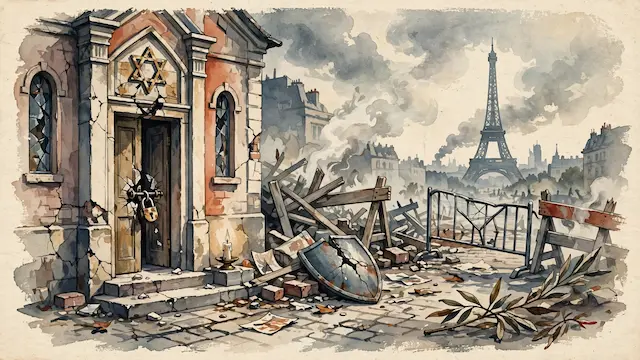
The article by David Ben-Basset criticizes French leadership, particularly President Emmanuel Macron, for a perceived disconnect between its international image and domestic reality, especially concerning recent riots and rising antisemitism. Ben-Basset argues that French Jews are disproportionately bearing the cost of these events, citing the desecration of a synagogue in Paris's 19th arrondissement, where the Ark of the Covenant was broken into and prayer items were thrown. He contends that the protests, sometimes featuring Palestinian flags and calls for "Free Palestine," have become a cover for hatred and antisemitism, forcing French Jews to apologize for Israeli actions.
Ben-Basset highlights statistics showing 1,320 antisemitic incidents in France in 2025, including an attack on a synagogue in La Grande-Motte and an injured police officer. He asserts that this reality necessitates national introspection, questioning why France requires security around Jewish institutions and suggesting the state must examine its failures. The author dismisses the need for more emotional speeches after future attacks, stating that evasion is not tolerance when dealing with Islamism.
A 2025 survey indicated that 44% of Muslim respondents favored their religious rules over French law, with some preferring Sharia law. Ben-Basset argues that a state cannot allow its laws to become mere recommendations dictated by a minority and that areas should not exist where law enforcement fears to tread. He criticizes politicians for fearing the Muslim electorate, prioritizing votes over principles, and weakening resistance to extremism out of fear of losing support.
The article also draws parallels to historical French actions, recalling the 1967 arms embargo that delayed Mirage jets ordered by Israel, which Ben-Basset views as a betrayal of trust. He further points to France's colonial past, mentioning torture and disappearances in Algeria, the killing of Algerian protesters in Paris in 1961, and the brutal suppression of a 1947 uprising in Madagascar. He notes Macron's 2024 acknowledgment of a massacre in Senegal from 80 years prior as a belated recognition of colonial cruelty and state ingratitude.
Ben-Basset directly addresses those waving Palestinian flags and chanting slogans, accusing them of strengthening a "monster" and provoking its appetite, turning the Palestinian flag into a symbol of hate. He concludes that France is paying the price for its hubris, with human rights subordinated to regime interests, and calls for leaders to acknowledge their responsibility, open archives, and give victims a more prominent place than a footnote in speeches. He asserts that history will not forget France's actions, even if it retracts support for Palestinian militants.
Mentioned


