
Israel's Skyscraper Boom Faces Challenge of Mixed-Use Development
Translated & summarized from Bizportal by baba
Israel's booming skyscraper construction is predominantly focused on office space, unlike global trends favoring mixed-use developments. A growing surplus of commercial real estate, coupled with high housing demand, highlights the need for integrated building designs. However, developers face engineering, legal, and financial challenges in converting offices to residences or building mixed-use towers, often preferring the stable income from commercial leases. This preference for single-use buildings persists despite regulatory support for conversions and evolving work patterns.
The story in 5 lines · by baba
- Israel's new skyscrapers are mostly office-only, unlike mixed-use towers common globally.
- A surplus of commercial space exists in Israel, while housing demand remains high.
- Globally, office buildings are increasingly being converted into residential units.
- Developers prefer single-use office towers for stable rental income over complex mixed-use projects.
- Engineering and legal hurdles complicate the development of mixed-use skyscrapers in Israel.
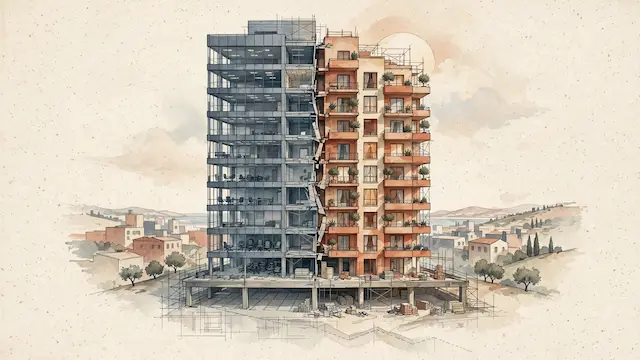
While Israel's skyline, particularly in the Gush Dan region, is rapidly ascending with new supertall buildings, the majority are exclusively designed for office space. This trend contrasts with global metropolises like Seoul, Kuala Lumpur, and New York, where mixed-use towers incorporating offices, hotels, and residences are commonplace. In Israel, however, this integrated approach remains rare, despite a growing surplus of commercial space and persistent high demand for housing in central areas.
Globally, the conversion of vacant office buildings into residential units is accelerating. In the U.S., over 90,000 apartments were in conversion processes by early 2026, a significant increase from previous years. New York City leads this trend, with plans for thousands of new apartments from former office spaces. This conversion is driven by high office vacancy rates, maturing loans on office buildings, and a housing shortage.
However, the Israeli context differs. While the U.S. is primarily converting older office buildings, Israel faces a debate over the design of new towers. Approved plans in Israel indicate a substantial surplus of office and commercial space, far exceeding projected demand. For instance, the Bursa area in Ramat Gan alone has plans for nearly 3 million square meters of employment space. Even in newly constructed, accessible towers, occupancy rates are moderate, with significant portions of space either vacant or in advanced negotiation stages.
The shift towards hybrid work models and advancements in artificial intelligence reduce the need for extensive office footprints. This surplus is expected to persist for at least five years. Simultaneously, the housing market in areas like Tel Aviv has a considerable inventory of unsold new apartments, often at high price points. Converting offices to apartments is seen as one potential solution, but its success hinges on location, unit size, and pricing.
Despite a 2022 law facilitating office-to-housing conversions and the potential to alter new tower designs, major developers continue to favor single-use office buildings. This preference is driven by the stable, long-term income generated from leasing offices to institutional tenants, compared to the more complex management and one-time sales or rentals of residential units. Engineering challenges, such as integrating "wet plumbing" for kitchens and bathrooms in every residential unit, the need for separate bomb shelters (Mamadim), and differing safety requirements for residential versus commercial spaces, also add complexity and cost to mixed-use developments. Furthermore, legal issues surrounding shared ownership in mixed-use buildings can lead to disputes, prompting some developers to opt for separate towers or exclusively commercial projects.
Mentioned
Not the same event — other stories that share this one’s people, places, or theme: background, reactions, and follow-ups.
