
Israel's $1.3 Million Chemical Experiment to Combat Algae Fails
Translated & summarized from Vesty by baba
Israel's Water Authority spent approximately 5 million shekels on an experimental chemical treatment using 70 tons of copper and aluminum sulfates to combat a microalgae bloom that disrupted desalination plants. The effort, which failed to resolve the issue and has unknown ecological consequences, led to a temporary fishing ban. Authorities cited climate change as a factor in the bloom, which has impacted water supply, and acknowledged the experiment's inconclusive results, halting further work.
The story in 6 lines · by baba
- Israel's Water Authority spent 5 million shekels on a failed chemical experiment to combat algae.
- 70 tons of copper sulfate and aluminum sulfate were discharged into the sea.
- The algae bloom disrupted five of Israel's six desalination plants, affecting water supply.
- A temporary fishing ban was imposed due to concerns about toxic substances.
- The long-term impact on the marine ecosystem remains under investigation.
- Authorities cited climate change as a contributing factor to the algae bloom.
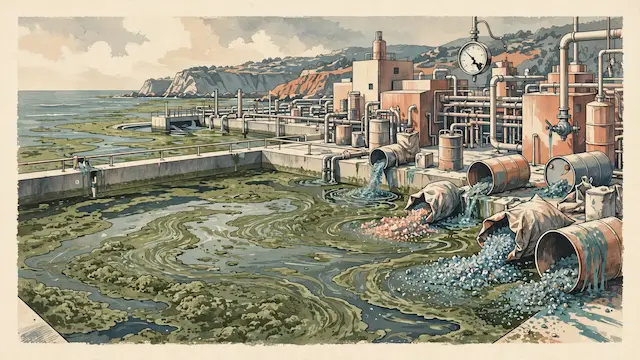
Israel's Water Authority spent approximately 5 million shekels (about $1.3 million) on an unsuccessful experiment to combat a microalgae bloom that disrupted the operation of the country's desalination plants. The authority discharged 70 tons of chemicals, including copper sulfate and aluminum sulfate, into the sea in an attempt to eliminate the algae, but the effort did not yield the desired results. The long-term consequences for the marine ecosystem are still under investigation, according to a report published Tuesday, October 20, by Calcalist, citing a government contracts report for the third quarter of 2026.
Israeli citizens were not informed in advance about the chemical discharge. Following the operation, the Ministry of Health imposed a temporary ban on fishing for several days to assess the impact of the toxic substances on local fish populations. The chemical treatment was intended to address the microalgae bloom, which had caused five of Israel's six desalination plants, responsible for 80% of the nation's water supply, to operate at partial capacity since August. The algae's microscopic size allowed them to penetrate intake filters and clog the expensive polymer membranes of the desalination facilities.
The situation in Israel is exacerbated by the poor condition of its natural water sources, including Lake Kinneret, coastal aquifers, and wells, which are suffering from prolonged drought, depletion, and pollution. Fearing a worsening water crisis, the Water Authority had already agreed to cover the cost of replacement membranes for private desalination plants to maintain partial operations. Simultaneously, authorities sought a rapid solution and approved the experimental chemical treatment, contracting the company BlueGreen for 5 million shekels.
The environmental ministry permitted the release of 40 tons of copper sulfate and 30 tons of aluminum sulfate, both known to be toxic to marine life. The experiment generated public outcry and ultimately failed to achieve its objective, with its ecological impact yet to be fully understood. Copper sulfate, or blue vitriol, is used against fungi and algae by releasing copper ions that disrupt cellular functions. However, it is not selective and can harm other aquatic organisms. Aluminum sulfate acts as a coagulant in water purification, helping to clump particles, including algae, for settling, and it also binds phosphorus, a nutrient for algae.
Dr. Zvi Steiner of the Institute of Earth Sciences at the Hebrew University warned that adding copper sulfate could disrupt the delicate ecological balance. He noted that copper is toxic to zooplankton, a food source for fish, and does not degrade, potentially cycling back into the water. Mass algae die-offs can also deplete oxygen, leading to fish mortality independent of copper toxicity. Furthermore, the treatment might favor copper-resistant algae strains. While the chemicals are harmful in high concentrations, the diluted amounts in seawater were not expected to pose a direct risk to human health for bathing, though ingestion of concentrated forms can cause gastrointestinal issues and eye irritation.
Israeli authorities described the algae bloom as unexpected, despite prior warnings from the state comptroller and documented cases in other countries, such as the Persian Gulf and Oman in 2009, where similar blooms halted desalination plants for extended periods. Climate change is increasing water temperatures globally, making such blooms a growing threat to desalination facilities worldwide. The Water Authority stated that the experiment's conclusions were inconclusive, leading to the decision not to continue the work.
Mentioned

