
Egypt Considers Military Aid to Saudi Arabia Against Houthis
Translated & summarized from Arab48 by baba
Egypt's parliament is set to vote on authorizing military assistance to Saudi Arabia against Houthi attacks, a move President el-Sisi requested. Analysts suggest this aims to prevent Israeli intervention and secure regional stability. The potential deployment comes amid escalating Houthi attacks and Egypt's own security concerns, including a drone attack on Damietta. Economically, Egypt relies on Gulf support, with Saudi Arabia holding a significant deposit in Egypt's central bank.
The story in 6 lines · by baba
- Egypt's parliament will vote next week on authorizing military aid to Saudi Arabia against Houthi attacks.
- President el-Sisi requested parliamentary approval for military assistance to Saudi Arabia.
- Analysts believe Egypt aims to prevent potential Israeli intervention in the conflict.
- Egypt's economic stability is closely tied to Gulf states, which have provided significant financial support.
- Security concerns, including a drone attack on Damietta, are driving Egypt's potential involvement.
- Potential Egyptian military contributions may include air defense and naval support, not ground troops.
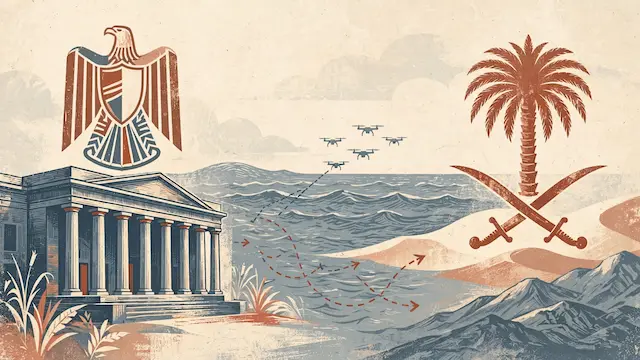
Egypt's parliament is expected to vote next week on authorizing the armed forces to assist Saudi Arabia in defending against Houthite attacks, should Riyadh request such support. This potential move could draw Egypt closer to direct military involvement in escalating conflicts. Analysts suggest one of Cairo's unstated objectives is to prevent potential Israeli intervention in the conflict, possibly under U.S. pressure, to aid Riyadh. President el-Sisi requested parliamentary approval on Saturday, stating Egypt "will never, ever forget our brothers in the Gulf" and assuring Saudi leaders that Cairo would take "any measure to protect you and defend you."
Sisi's remarks mark a clear escalation from Egypt's previously more moderate tone. While Egypt has consistently expressed strong support for its Gulf allies, it had not publicly committed to a direct combat role. Egyptian Rafale fighter jets were reportedly present in the UAE during el-Sisi's May visit, though Egyptian media did not mention their deployment. Egypt has not joined a joint defense pact signed by Saudi Arabia with Turkey and Pakistan, though it is considering it. This shift in rhetoric follows increased Houthi attacks on Saudi oil facilities and infrastructure. Saudi Crown Prince Mohammed bin Salman visited Egypt last month to discuss ensuring navigation freedom and security in the Bab el-Mandeb Strait and the Red Sea.
Egypt's economic stability is closely tied to the Gulf oil-producing states, with remittances from Egyptian expatriate workers being a vital source of foreign currency. Saudi Arabia, the UAE, and other Gulf nations have been major financial backers of el-Sisi's government, providing billions of dollars in aid, central bank deposits, and investments since the military ousted President Mohamed Morsi in 2013. Saudi Arabia has a $5.3 billion deposit with the Egyptian Central Bank due this month, plus $267 million in interest.
Growing security concerns also appear to be driving Cairo's more active stance. A drone attack on two gas ships in the Mediterranean coastal city of Damietta in July highlighted that Egypt cannot remain isolated from the conflict. Experts believe Egypt recognizes it cannot indefinitely remain on the sidelines, citing both economic and security fears. Both Saudi Arabia and Egypt have a shared interest in securing Red Sea shipping lanes, a crucial route for Saudi oil, especially with the Strait of Hormuz potentially closed. Egypt also earns billions annually from Suez Canal transit fees. Egyptian political researcher Sherif Arif stated that these intertwined concerns mean "Saudi security constitutes a dimension of Egyptian national security."
Egypt possesses one of the largest armies in the Arab world, with hundreds of thousands of active personnel and substantial air, land, and naval assets. Its air force operates U.S. F-16s, French Rafales, and Russian MiG-29s. Egypt receives approximately $1.3 billion annually in U.S. military aid, which helps fund its purchases of American military equipment. Washington waived human rights conditions on a portion of this funding this year, citing Cairo's "useful role" since the war began. The Egyptian armed forces have experience in counter-insurgency operations in the Sinai Peninsula and have contributed air and naval forces to the Saudi-led coalition in Yemen since 2015. Egypt also conducted airstrikes against ISIS targets in Libya. However, Egypt has not undertaken large-scale ground deployments abroad since the 1991 Gulf War. Earlier, in the 1960s, President Gamal Abdel Nasser sent Egyptian troops to Yemen in a costly intervention.
El-Sisi's address did not specify the type of military forces Egypt might deploy. Military analysts consider deploying troops within Yemen itself unlikely. Retired Egyptian military officer Samir Ragheb suggested that the most probable contributions would involve air defense and naval support, particularly against missile and drone threats. He also noted the navy's role in protecting ships and conducting anti-piracy operations. Andreas Krieg, a senior lecturer in security studies, stated that another large Arab army entering the conflict would not suddenly solve the Houthi problem. He suggested Cairo could instead bolster Saudi resilience, improve Red Sea control, share the defense burden, and increase the political cost of continued attacks.
Mentioned
The same event, reported separately by each outlet. Open a few to compare what different newsrooms emphasize — and what they leave out.
Centre 1Arab 1

Not the same event — other stories that share this one’s people, places, or theme: background, reactions, and follow-ups.
