
Bank Leumi Economists Warn Against Expected Interest Rate Cuts
Translated & summarized from Ice by baba
Economists at Bank Leumi predict no interest rate cuts in the next year, despite recent low inflation in Israel. They cite the shekel's depreciation, potential tax hikes, and rising fuel costs as reasons for an increased inflation forecast. The Bank of Israel is expected to announce its next interest rate decision on October 21st, with the current rate at 3.25%. The economists' outlook reflects broader uncertainty regarding Israel's monetary policy.
The story in 5 lines · by baba
- Bank Leumi economists forecast no interest rate cuts in Israel within the next year.
- They raised their 12-month inflation forecast to 2.3% due to currency and tax concerns.
- The Bank of Israel will announce its interest rate decision on October 21st.
- The current interest rate in Israel stands at 3.25%.
- Political uncertainty and global rate hikes contribute to the outlook.
Despite a sharp drop in the consumer price index in September and low inflation, economists at Bank Leumi are not anticipating any interest rate reductions in the coming year. A review published by the bank's economic department suggests the likelihood of a rate cut is similar to the chance of a rate hike. The Governor of the Bank of Israel, Prof. Amir Yaron, is set to announce the next interest rate decision on Wednesday, October 21st. The current interest rate stands at 3.25%, following a quarter-percentage-point decrease in the previous decision. Alongside the announcement, scheduled for 4:00 PM, the bank will also release updated macroeconomic forecasts, and Governor Yaron will hold a press conference.
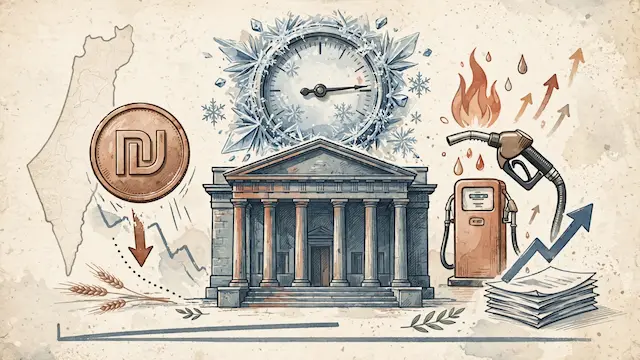
While the 12-month inflation rate concluded at 1.6%, within the Bank of Israel's price stability target of 1%-3%, Bank Leumi economists have raised their inflation forecast for the next 12 months to 2.3%. This upward revision is attributed to the shekel's depreciation over the past five months, potential tax increases following the formation of a new government, and an anticipated rise in fuel prices due to increased excise tax. The review notes that the government's reduction of fuel excise tax stabilized prices in September and October, but without a budgetary source to continue this reduction, fuel prices are expected to gradually increase from November.
Bank Leumi's monthly forecast projects a 0.2% rise in the October index, a 0.1% decrease in November, and a 0.2% increase in December. Inflation for the entirety of 2026 is expected to be 1.9%, but the 12-month outlook remains at 2.3%. The economists conclude that despite low inflation, markets are not pricing in rate cuts within the next year, a view they share, particularly given expected rate hikes in most developed countries. The shekel's depreciation and political uncertainty are also expected to influence the decision, with the probability of a rate cut seen as similar to that of a hike over the next year.
This analysis from Bank Leumi's financial division highlights the growing general uncertainty surrounding the Bank of Israel's monetary policy. Economists across Israel are finding it difficult to predict the governor's actions amidst global interest rate hikes, fluctuating inflation data, and the impending dramatic elections, which could further increase uncertainty without a clear outcome.