
Houthis Show Growing Military Strength With Attacks on Saudi Arabia
Translated & summarized from Davar by baba
Houthi rebels in Yemen have demonstrated growing military capabilities by launching repeated attacks on Saudi Arabia's main international airport and oil facilities, hundreds of kilometers from their border. Despite advanced weaponry and past interventions by international powers, Saudi Arabia is struggling to counter the assaults. A senior Saudi diplomat accused Iran of encouraging the escalation, which has resulted in at least 19 deaths and significant disruptions. The Houthis' arsenal includes missiles and drones capable of reaching Israel, and their numbers have surged to an estimated 350,000 fighters.
The story in 6 lines · by baba
- Houthi rebels launched repeated attacks on Saudi Arabia's main international airport and Aramco facilities, hundreds of kilometers from Yemen.
- Saudi Arabia is struggling to counter the Houthi assaults despite possessing advanced U.S.-supplied weaponry.
- A senior Saudi diplomat accused Iran of encouraging the Houthi escalation and stated the rebels rejected negotiation offers.
- The Houthis' arsenal includes missiles and drones capable of reaching all Gulf states and Israel.
- Houthi fighter numbers have surged to an estimated 350,000, a significant increase since 2015.
- At least 19 people have been killed, and disruptions threaten Saudi Arabia's economic and tourism plans.
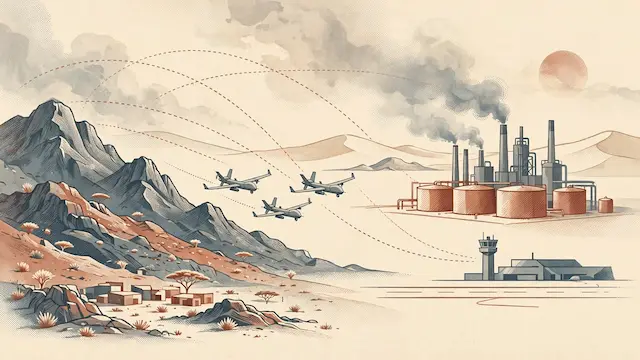
The Iran-backed Houthi rebels in Yemen have demonstrated increasing military capabilities in recent weeks, launching repeated attacks on Saudi Arabia's main international airport hundreds of kilometers away and seizing territory within Yemen near a strategic maritime strait. Despite decades of air strikes by Saudi Arabia, the UAE, the United States, Britain, and Israel, the Houthis have grown stronger. Saudi Arabia is struggling to counter the recent assaults, even with advanced U.S.-supplied weaponry. A senior Saudi diplomat stated that Iran is encouraging the escalation and that the Houthis rejected negotiation offers over the summer. The Houthis operate in vast mountainous terrain, allowing them to disperse fighters and military infrastructure, posing a threat to key oil facilities and critical trade routes. According to UN experts and other sources, Iran and its allies in Lebanon and Iraq provide the Houthis with knowledge, training, and advanced weapons. A recent report revealed that the Houthis attempted to acquire components for long-range ballistic missiles from Chinese suppliers. The Houthis possess an extensive arsenal of ballistic missiles, cruise missiles, and drones, many resembling Iranian models, capable of reaching all Gulf states and Israel. They have also used advanced anti-ship missiles and uncrewed vessels to attack ships in the Red Sea, threatening a vital trade route. Iran denies arming the Houthis, which would violate a UN arms embargo. China has not directly responded to the report but stated it takes a "cautious and responsible" approach to military exports. Smuggled weapons and components from Iran have been intercepted en route to Yemen, and a 2024 UN experts' report documented extensive military ties between the Houthis, Iran, and its allies. That report estimated Houthi fighter numbers had risen to approximately 350,000 by 2024, a significant increase from about 30,000 in 2015 when Saudi Arabia intervened in Yemen's civil war. The Houthis utilize relatively inexpensive drones and missiles to strike oil infrastructure and other targets across the Saudi border, as well as tankers offshore. While Iran is believed to supply advanced components like guidance systems, the Houthis can locally produce many of their weapons at a much lower cost than the advanced interceptors used by the Saudis. Some estimates suggest the rebels are exploring artificial intelligence for more effective missile development. Saudi Arabia possesses U.S.-supplied weaponry, including advanced fighter jets and air defense systems. However, due to pressure on its advanced interceptor stocks, it is unclear how long the kingdom can fend off attacks not only from the Houthis but also from Iran-backed militias in Iraq. Recent Houthi attacks on King Khalid International Airport in Riyadh have led to flight cancellations and have also hit the headquarters of the national oil company, Aramco. These targets are hundreds of kilometers from Yemen's border. At least 19 people have been killed, school classes were canceled, and the disruptions threaten Saudi Arabia's ambitious plans to become a global hub for business and sports tourism.
Mentioned


