
Dollar Hits Highest Level Since Early April Against Shekel
Translated & summarized from Calcalist by baba
The U.S. dollar reached its highest closing point against the Israeli shekel since early April, trading at 3.1116 shekels on Friday. This rise follows stronger-than-expected U.S. inflation data and reflects Israel's increasing integration with global financial markets. Experts note that currency hedging by institutional investors and U.S. tech sector performance now significantly impact the shekel's value.
The story in 5 lines · by baba
- The U.S. dollar closed at 3.1116 shekels on Friday, its highest level since April 7.
- The euro and British pound also saw gains against the shekel.
- Stronger-than-expected U.S. inflation data contributed to the dollar's appreciation.
- The dollar had previously fallen to a low of 2.80 shekels in late May.
- Experts link the shekel's volatility to global financial markets and U.S. tech sector performance.
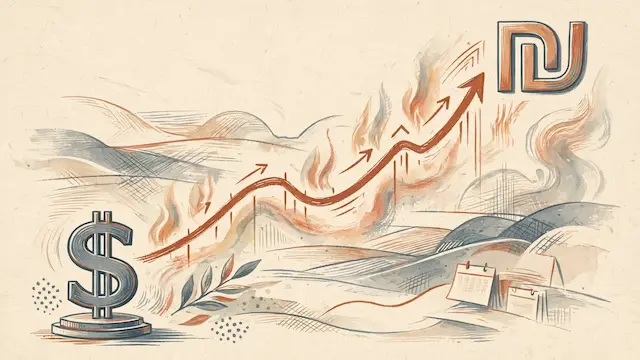
The U.S. dollar rose 0.2% to 3.1116 shekels on Friday, its highest closing level since April 7. The euro strengthened by 0.2% to 3.482 shekels, and the British pound gained 0.5% to 4.132 shekels.
During trading, the dollar reached 3.1168 shekels, its highest point since April 8. The currency had previously fallen to a low of 2.80 shekels in late May, its lowest since 1993, before climbing approximately 11%.
Factors influencing the dollar's rise include the release of U.S. Consumer Price Index data on Wednesday, which showed a 3.7% annual increase, exceeding the expected 3.6%. Additionally, U.S. Producer Price Index data for September, released Thursday, also surprised with a monthly increase of 1.3% and an annual rate of 6.3%.
Dr. Bella Barada Barkat, a macroeconomic and geopolitical commentator, stated that the dollar's rise against the shekel doesn't necessarily indicate a weakening Israeli economy. Instead, she explained, it reflects Israel's growing dependence on global financial markets. As Israeli pension funds and institutional investors increase their exposure to foreign assets, the exchange rate becomes more sensitive to fluctuations on Wall Street and currency hedging activities.
Barkat elaborated that when U.S. stock markets decline, institutions may need to buy dollars to adjust their hedging, further pressuring the shekel. Concerns over the financing costs of artificial intelligence infrastructure have created an interesting link between the valuation of U.S. tech companies and Israel's exchange rate. Understanding the dollar's trajectory now requires monitoring global financial markets, particularly the U.S. tech sector, in addition to security situations and local interest rate decisions.
Mentioned



