
US May Use 'Mother of All Bombs' Against Iran in Decisive Strike
Translated & summarized from Cursorinfo by baba
Professor Uzi Rabi suggests the U.S. may consider using the MOAB bomb against Iran as part of a strategy for a swift, decisive strike. The bomb's effectiveness against Iran's fortified underground nuclear facilities near Natanz is questioned. While President Trump may be using the threat for psychological pressure, a potential short war could target key Iranian infrastructure. Israel has a vested interest and could play a role, but the ultimate success depends on strategic goals beyond mere explosive power.
The story in 6 lines · by baba
- The U.S. may consider using the MOAB bomb against Iran as a decisive strike, according to Professor Uzi Rabi.
- The MOAB bomb is designed for surface destruction and its effectiveness against Iran's deep underground nuclear facilities is questioned.
- The potential use of the MOAB could signal a shift in U.S. strategy towards a swift, short war.
- President Trump may be using the threat of the MOAB for psychological pressure or preparing for an actual strike.
- Israel has a direct interest in preventing Iran from acquiring nuclear weapons and may participate in or act parallel to any U.S. operation.
- The effectiveness of any strike depends on achieving strategic goals beyond explosive power, such as regime change or neutralizing Iran's capabilities.
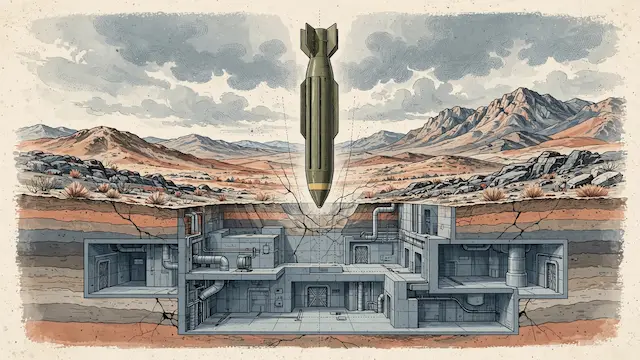
The United States may be considering the use of its most powerful non-nuclear bomb, the MOAB, against Iran, a move that could signal a shift in U.S. strategy from attrition to a decisive, swift blow, according to Professor Uzi Rabi writing for Walla. The MOAB, weighing approximately 10 tons, is designed for widespread surface destruction, not for penetrating deep underground bunkers like the GBU-57. Its potential deployment near Iran's Natanz nuclear facility, believed to house fortified underground sites, raises questions about its effectiveness for the intended target, as intelligence suggests a reinforced nuclear facility may be located within Pickaxe Mountain.
The author suggests the core question is not the bomb's destructive capability but the strategic objective behind threatening its use. President Trump faces a dilemma: while sanctions have weakened Iran's leverage, the regime continues to threaten shipping in the Strait of Hormuz and challenge U.S. influence. This situation could lead to a new U.S. scenario: a short, potentially three-day war targeting Iran's nuclear facilities, energy infrastructure, and key power centers, aiming to alter the Iranian leadership's perception of survival.
Rabi cautions that preparing a contingency plan is not the same as deciding to launch an attack. Trump may be using threats for psychological pressure or preparing for an operation before or after the U.S. midterm elections. This uncertainty keeps Iran on edge without committing the U.S. to immediate conflict. The author posits that such an attack could be a prelude to U.S. withdrawal, replacing prolonged military presence with a decisive strike declared as a victory.
However, Iran could retaliate with missile strikes and attacks on Gulf infrastructure, potentially extending a short U.S. bombing campaign into weeks of Iranian response. Israel, with its intelligence capabilities and direct interest in preventing Iran from acquiring nuclear weapons, would not remain passive. While Israel's role in U.S. plans is unconfirmed, it could participate in planning, provide intelligence, or act independently. For Israel, the critical outcome is whether an attack would lead to regime change, neutralize Iran's retaliatory capacity, and destroy deep-seated nuclear facilities. Otherwise, Israel might face a weakened but vengeful adversary. Rabi emphasizes that the MOAB is not a magic solution, and explosive power does not substitute for strategy. The ultimate question is whether Trump aims to deter further escalation with the threat of a final strike or believes such a strike is necessary to escape a strategic impasse, paradoxically threatening escalation to end a conflict.
Mentioned




