
Gaza Olive Harvest Plummets Amid Destruction and Restrictions
Translated & summarized from Panet by baba
Gaza's olive harvest has drastically declined due to widespread destruction of groves and Israeli military restrictions. Farmers like Haider Abu Madin report losing most of their trees, significantly reducing oil production from thousands of tons to mere barrels. Prices have tripled, making olive oil unaffordable for many Gazans, while the number of operational olive presses has fallen from 40 to seven. Harvest workers like Ahmed Khader now face scarce work and dangerous conditions near restricted zones.
The story in 6 lines · by baba
- Gaza's olive harvest has plummeted due to widespread destruction and Israeli restrictions.
- Olive groves once spanning 220 acres now have only 20-30 trees remaining for some farmers.
- Estimated olive production has fallen from 40,000 tons to 5,000 tons annually.
- Olive oil prices have tripled, reaching nearly $500 per barrel, making it unaffordable.
- The number of operational olive presses has decreased from 40 to just seven.
- Harvest workers face scarce employment and dangerous conditions near restricted areas.
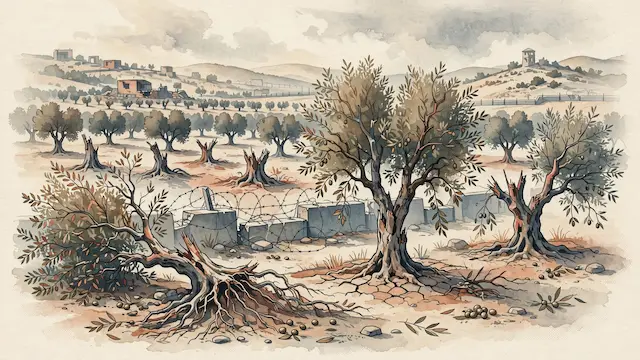
Olive farmers in Gaza are struggling to salvage what remains of their harvest amidst widespread destruction of groves and Israeli restrictions. Haider Abu Madin, a 60-year-old owner of a once-thriving 220-acre olive grove in central Gaza, described how nearly half of his land is now behind the "yellow line" where Israeli forces operate, preventing access. The remaining half has been largely bulldozed, leaving only about 20 to 30 trees. Abu Madin estimates this year's yield will be a mere two barrels of oil, insufficient even for his family, a stark contrast to the 1100-1500 tons of olives and hundreds of barrels of oil his family's groves produced before the war.
Before the conflict, olives were a cornerstone of Gaza's agriculture, providing a staple food, a small export surplus, and a shaded refuge for families. However, Gaza's agricultural authorities estimate that out of two million olive trees, only about 150,000 remain. They anticipate a harvest of around 5,000 tons of olives, compared to 40,000 tons previously, yielding only 700 tons of oil instead of 5,000.
The scarcity has driven up prices significantly. Imad Al-Ajrami, a shopper in Deir al-Balah market, noted that available olives and oil are selling for triple pre-war prices, reaching nearly $500 per barrel, far beyond the purchasing power of most Gazan families. The number of operational olive presses has also dwindled from around 40 to just seven, with many struggling to function due to the lack of olives, as Fawaz Zeidan, an olive press owner, lamented.
Despite the devastation, some families are still attempting to harvest. Khalil Mansi and his family were seen gathering olives in one of the few remaining groves in Deir al-Balah, a small area in central Gaza declared safe by Israeli forces. Ahmed Khader, a harvest worker, stated that what used to be a two-to-three-month job is now barely a day's pay. He described working under the constant fear of gunfire and shelling near the "yellow line" and Salah al-Din road, driven by the need to provide for his children.
Mentioned


