
Israel's Last Retaliation Raid: The Costly Battle of Qalqilya
Translated & summarized from Haaretz by baba
Israel's final major retaliation raid occurred on October 10, 1956, targeting Qalqilya's police station after two deadly Jordanian-backed terror attacks. The operation resulted in 18 IDF soldiers killed and 68 wounded, alongside 88 Jordanian soldiers dead. A Haaretz editorial justified the costly raid, stating it demonstrated Israel's commitment to peace through its policy of restraint.
The story in 5 lines · by baba
- Israel conducted its last major retaliation raid on October 10, 1956, targeting Qalqilya's police station.
- The raid was a response to two deadly terrorist infiltrations from Jordan that killed 7 Israelis.
- The operation resulted in 18 IDF soldiers killed and 68 wounded, with 88 Jordanian soldiers also dead.
- The battle involved fierce fighting and significant resistance, exceeding expectations.
- A Haaretz editorial argued the raid proved Israel's commitment to peace despite the high cost.
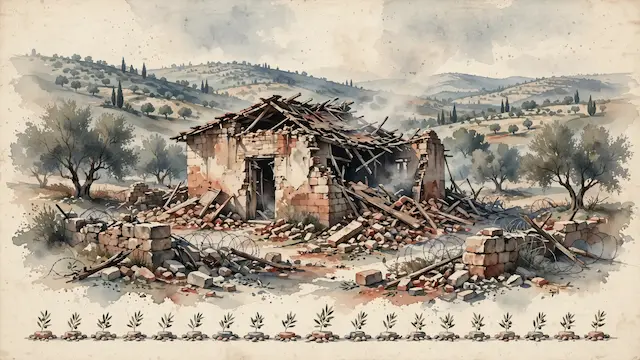
Seventy years ago, on October 10, 1956, Israel launched its final major retaliation raid of its first decade, targeting the police building in Qalqilya, a Jordanian town near the armistice line. The operation, detailed in a Haaretz report from the time, was a direct response to two deadly terrorist attacks carried out by infiltrators from Jordan that same month. The first attack, by the "Desert Commando" gang, resulted in the murder of five Solel Boneh workers on the Beersheba-Sodom road. Days later, on October 9, another infiltrator cell killed two workers in a Sharon orchard.
Israel's government concluded that its prior policy of restraint was being interpreted as weakness, prompting a decision for a forceful response. The Chief of Staff's proposal to demolish the Qalqilya police station was approved by the government. The operation commenced with shelling of Jordanian army positions, followed by the paratrooper battalion, led by Mordechai (Motta) Gur, seizing and demolishing the police station. The fierce battle, lasting about two hours, involved heavy fighting and significant explosions, as described by Haaretz correspondent Edwin Roth.
The raid came at a high cost: 18 IDF soldiers were killed and 68 wounded during the 20-minute operation. The paratroopers brigade, under Ariel Sharon, faced unexpected strong resistance and became engaged in a difficult battle with Jordanian forces that surrounded them, leading to the deaths of ten additional soldiers during a rescue attempt. On the Jordanian side, 88 soldiers were killed. This operation marked the highest casualty count for both sides in any prior retaliation raid and resulted in an unusual number of commendations for IDF soldiers.
Retaliation raids were a key deterrence strategy for the IDF in the 1950s and 60s, typically in response to terror attacks by "Fedayeen" infiltrators from Egypt and Jordan. The underlying principle was a "strong hand" approach to punish any sabotage or combat actions. While the Qalqilya raid was the last on the Jordanian border in the 50s, similar actions resumed in 1965 with the start of Fatah attacks. An editorial in Haaretz justified the operation despite the heavy price, arguing that Israel's adherence to peace was demonstrated by its restraint, contrasting it with how other nations might have reacted to similar border incursions with a declaration of war.