US Military Prepares 3-Day Strike on Iran, Trump Delays Decision
Translated & summarized from Ynet by baba
The U.S. military has prepared plans for a three-day strike on Iran, but President Donald Trump has delayed a decision, reportedly rejecting five previous proposals. Trump stated the U.S. would not attack before the November 3 midterm elections, citing "fruitful talks." Meanwhile, the U.S. is amassing significant naval forces in the Middle East, including three aircraft carrier strike groups. Concerns persist over Iran's improved military capabilities and the potential for a large-scale Iranian response to any U.S. strike.
The story in 6 lines · by baba
- U.S. military plans for a three-day strike on Iran are ready, pending President Trump's approval.
- President Trump has delayed any decision on attacking Iran until after the November 3 midterm elections.
- The U.S. is deploying three aircraft carrier strike groups to the Middle East, a significant military buildup.
- Iran has improved its military capabilities, posing a greater challenge to potential U.S. strikes.
- Escalating Iranian attacks on shipping continue in the Persian Gulf and Strait of Hormuz.
- Israeli Chief of Staff Eyal Zamir warned that an attack could lead to the postponement of Israeli elections.
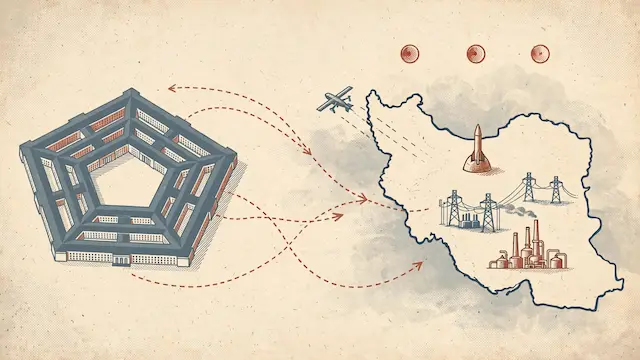
The U.S. military has prepared plans for an intensive, three-day military operation against Iran, according to sources cited by The New York Times. Despite extensive military preparations and escalating Iranian attacks on oil tankers, President Donald Trump has hesitated to renew significant hostilities, reportedly rejecting five proposals for major military actions against Iran or its Houthi allies in Yemen in recent months. Trump has ordered strike options to be prepared, and senior administration officials discussed plans at Camp David last Friday, led by Vice President J.D. Vance. A key focus was a short, powerful operation targeting Iran's missile and drone systems, some of which have been rebuilt by the Revolutionary Guards. Other potential targets include energy facilities and Revolutionary Guard command centers.
However, Trump stated on Truth Social that the U.S. would not attack Iran before the November 3 midterm elections, claiming "fruitful talks" were underway and that the U.S. blockade would continue. He asserted Iran is in a very difficult economic and military position. The New York Times reported that national security and Pentagon staff presented Trump with five proposals for significant military operations against Iran or the Houthis, all of which he declined. This hesitation is also reflected in a comparatively limited U.S. response to recent Iranian attacks, a shift from the summer when the U.S. routinely responded to attacks on international shipping.
Amid the White House's deliberations, the U.S. military is amassing forces in the Middle East. Three U.S. aircraft carrier strike groups are expected in the region soon, a concentration not seen since the 2003 invasion of Iraq. The USS Roosevelt is set to join the USS Washington and USS Bush by late October, bringing over 20,000 sailors and Marines and hundreds of aircraft. This buildup is expected to be temporary, with the USS Washington scheduled to return to Japan after the Roosevelt arrives. Military commanders are ready to launch an operation if Trump changes his mind, though it remains unclear if he will approve an attack after the elections.
Concerns about Iran's improved military capabilities, including enhanced targeting methods aided by Chinese satellite imagery, are a factor in the reluctance to strike. Iran's evolving attack patterns necessitate more interceptors, straining U.S. defensive munitions. The Pentagon has redeployed systems from other regions to the Middle East, raising worries about dwindling supplies and the ability to protect bases, energy facilities, and civilian infrastructure. A renewed strike could provoke a significant Iranian response, further depleting defensive resources.
U.S. embassies in the Middle East have issued joint security warnings to American citizens, urging heightened vigilance due to the complex security situation. The warnings note potential escalations and the possibility of attacks on U.S. interests globally. Meanwhile, Iran has continued to attack vessels in the Persian Gulf and Strait of Hormuz, with at least 13 ships targeted since September, though the actual number may be higher. Despite these attacks, the U.S. has avoided large-scale strikes within Iran, focusing instead on intercepting Iranian drones and cruise missiles.
Diplomatic efforts continue, but Washington and Tehran remain divided on the negotiation agenda, with the U.S. prioritizing nuclear program discussions and Iran insisting they occur last. Iran has shown no willingness to halt uranium enrichment or relinquish its enriched uranium stockpile. The political calendars in Israel and the U.S. are also significant factors, with U.S. officials previously anticipating a strike only after Israel's October 27 elections and the U.S. November 3 elections. Israeli Chief of Staff Eyal Zamir was reportedly warned of a potential strike within three weeks, and he indicated such an attack could lead to the postponement of Israeli elections due to expected Iranian missile responses.
Mentioned
The same event, reported separately by each outlet. Open a few to compare what different newsrooms emphasize — and what they leave out.
Centre 2Haredi 1



Not the same event — other stories that share this one’s people, places, or theme: background, reactions, and follow-ups.