Iran Rebuilds Nuclear Weapons Development Site After Israeli Attack
Translated & summarized from Now 14 by baba
Satellite images from September and October 2026 reveal significant activity at Iran's Minzadaye nuclear facility, northeast of Tehran, following an Israeli attack in March 2026. The site, linked to nuclear weapons development, shows extensive rebuilding efforts and vehicle presence, suggesting Iran is working to restore capabilities lost in the strike. Analysts believe this indicates a high priority for the Iranian regime to re-establish nuclear weapons development infrastructure.
The story in 5 lines · by baba
- Iran's Minzadaye nuclear facility shows significant renewed activity following an Israeli attack in March 2026.
- Satellite imagery from September and October 2026 reveals extensive rebuilding and vehicle traffic at the site.
- The facility is linked to nuclear weapons development and is believed to be a top priority for the Iranian regime.
- Analysts suggest Iran is attempting to restore critical capabilities lost in the March attack.
- The site received equipment from the Turquzabad "nuclear warehouse" exposed in 2018.
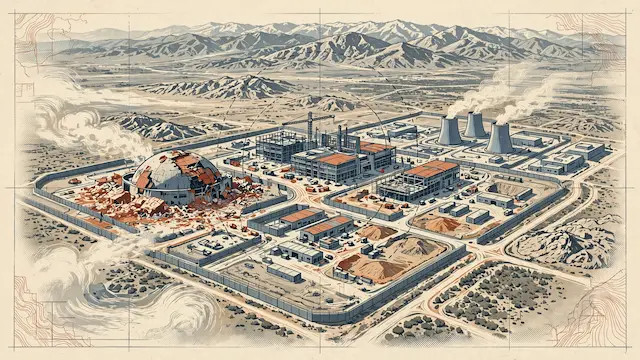
Satellite imagery from September and October 2026 indicates significant renewed activity at the Minzadaye complex, northeast of Tehran, months after it was damaged in an Israeli strike on March 3, 2026. The site, previously linked to nuclear weapons development, shows extensive earthworks, debris removal, and heavy vehicle traffic. Analysts at the Institute for Science and International Security (ISIS) suggest this activity points to an Iranian effort to restore critical capabilities lost in the attack, though satellite photos alone do not definitively prove production has resumed.
The Minzadaye complex was revealed by Israel during the 2026 war. The March strike reportedly destroyed several structures and damaged underground facilities. Recent images show a large-scale cleanup operation, including the removal of rubble and repair of damage to the mountainside. One area hit in March is now undergoing continuous earthworks, with a surface designed to resemble a courtyard, which had previously shown numerous craters from the attacks.
Between early September and early October, substantial vehicle presence was observed throughout the complex. Cars were parked in the lot outside the security perimeter, while numerous private vehicles and trucks were seen within the secure site itself. Researchers believe this renewed activity suggests Iran is prioritizing the re-establishment of nuclear weapons development capabilities and the restoration of what was destroyed.
Prior to the attack, activity at the complex was likely focused on research and development of nuclear warheads, according to public reports and IDF statements. The IDF stated at the time that a group of nuclear scientists was secretly working to develop a key component of a nuclear weapons system, and the complex was intended to enable the restoration of necessary technology and advancement of nuclear weapons development capabilities. The resumption of activity at the secure site indicates the work is likely a top priority for the Iranian regime.
Further information from September 2026 indicated that nuclear weapons-related infrastructure at Minzadaye was established in 2022, receiving equipment from the "nuclear warehouse" at Turquzabad. This site was exposed by Prime Minister Benjamin Netanyahu in September 2018, after Iran removed containers believed to contain nuclear material and weapons development equipment. When the IAEA visited Turquzabad in March 2019, evidence of nuclear material or contaminated equipment was found, and the agency has since demanded answers from Iran regarding the whereabouts of these materials. According to reports, Iran used the Minzadaye complex to establish an "industrial nuclear headquarters for the restoration of research, development, and adaptation of nuclear warheads," including means for producing enriched uranium cores and the high explosives needed for the detonation chain.
The same event, reported separately by each outlet. Open a few to compare what different newsrooms emphasize — and what they leave out.
Centre 5Right 3Haredi 1Arab 1












Not the same event — other stories that share this one’s people, places, or theme: background, reactions, and follow-ups.