
Satellite Images Reveal Renewed Nuclear Activity at Israeli-Targeted Iranian Site
Translated & summarized from Ynet by baba
Satellite images from September and October 2026 show renewed activity at Iran's Min-Zadayi nuclear weapons development site, previously targeted by Israel. The images reveal extensive cleanup, earthmoving, and vehicle presence, suggesting an effort to restore nuclear weapons development capabilities. This follows earlier attacks in March 2026 and a larger US-led strike in June 2025, which damaged Iranian nuclear facilities but did not fully halt the program.
The story in 5 lines · by baba
- Satellite images from September-October 2026 show renewed activity at Iran's Min-Zadayi nuclear site.
- The site was previously attacked by Israel during the "Roaring Lion" operation in March 2026.
- Activity includes cleanup, earthmoving, and significant vehicle presence, indicating restoration efforts.
- This suggests Iran is trying to rebuild nuclear weapons development capabilities.
- Previous attacks in June 2025 by the US and Israel damaged facilities but did not end the program.
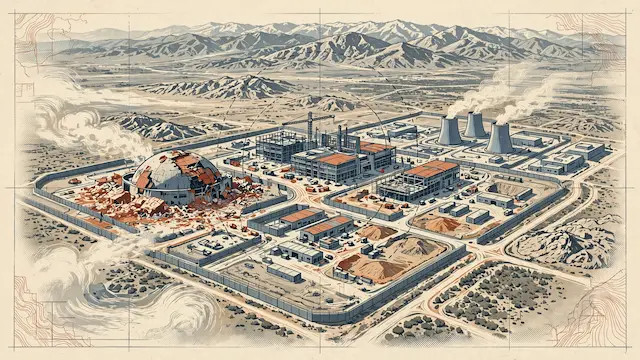
High-resolution satellite images from September and October 2026 indicate significant renewed activity at the Min-Zadayi nuclear weapons development complex northeast of Tehran. This site was previously exposed and attacked by Israel during the "Roaring Lion" operation, which reportedly destroyed several above-ground and possibly underground structures. The findings were published in the journal of the Institute for Science and International Security (ISIS).
The latest satellite imagery shows a return to regular vehicle traffic around the site, following an extensive cleanup operation that included debris removal and repairs to a damaged hillside. In one of the areas hit in March 2026, ongoing earthmoving activities are visible. These operations are taking place on a surface designed to resemble a courtyard, marked by numerous craters from the earlier attacks. A substantial number of vehicles, including cars and trucks, were observed within the complex and in a parking lot outside its security fence between early September and early October 2026.
This activity suggests an Iranian effort to restore nuclear weapons development capabilities and recover what was lost in the March 2026 attack. According to the journal, the work at the site likely involved research and development of nuclear warheads. The IDF had previously stated that a group of nuclear scientists was secretly working to develop a key component for Iran's nuclear weapons program, and that the complex was intended to facilitate the restoration and advancement of nuclear weapons development capabilities.
Additional information from the X account IntelliTimes@, posted on September 24, 2026, claimed that nuclear-related infrastructure was established in 2022 and incorporated elements from the "nuclear warehouse," a term commonly used for the Turqazabad site revealed by Prime Minister Benjamin Netanyahu in September 2018. Netanyahu exposed Turqazabad after Iran removed over a dozen shipping containers, believed to contain nuclear material and equipment relevant to its nuclear weapons program.
When the IAEA visited Turqazabad in March 2019, it found evidence of contaminated nuclear material or equipment. The IAEA Board of Governors has since pressed Iran for answers regarding the current location of this material or equipment. IntelliTimes@ reported that Iran did not simply move the material to a new long-term storage site but used Min-Zadayi as an "industrial nuclear headquarters" to rebuild infrastructure for developing nuclear warheads, including means for producing enriched uranium cores and the necessary explosives.
Previous extensive strikes against Iranian nuclear targets occurred throughout the conflict. In late June 2025, the US led a massive strike involving B-2 bombers and Tomahawk missiles against Iran's main nuclear sites. In July 2025, Iran officially acknowledged severe damage to its facilities, while the IDF released satellite images estimating that these operations had set back the nuclear program by years. Concurrently, the Israeli Air Force destroyed significant components at a facility in Isfahan, though Western intelligence sources qualified that the bomber strikes primarily affected external structures and tunnel entrances. Despite prolonged fighting, former officials and intelligence systems warned that the attacks had damaged, but not eliminated, the program. Professional assessments in August 2026 indicated that Iran's stockpile of 60% enriched uranium remained largely intact, and the regime was moving thousands of advanced centrifuges to protected underground sites. This situation, as reported in September 2026, led to accelerated US preparations for further targeted bombings to prevent Iran from achieving nuclear weapons capability.
Mentioned
The same event, reported separately by each outlet. Open a few to compare what different newsrooms emphasize — and what they leave out.
Centre 3Right 1Haredi 1Arab 1






Not the same event — other stories that share this one’s people, places, or theme: background, reactions, and follow-ups.