Northern Israel Rivers Deemed Potentially Dangerous Due to High Pollution Levels
Translated & summarized from Panet by baba
Israel's Health and Environmental Protection ministries have warned that several northern rivers are potentially dangerous due to high bacterial pollution, with E. coli levels exceeding recommended limits. Readings taken October 4-5, 2026, showed contamination in rivers including the Jordan, Hatzbani, and Banias, with some sites showing over 2,000 bacteria per 100 ml. The source of the pollution remains unknown, and authorities will continue monitoring the situation.
The story in 6 lines · by baba
- Northern Israel rivers Banias, Hatzbani, Jordan, and others are potentially dangerous due to high bacterial pollution.
- E. coli levels in affected rivers exceed the Health Ministry's recommended limit of 400 per 100 ml.
- Readings taken October 4-5, 2026, showed contamination levels up to 2,100 in Hamshushim Pool.
- Entry into specific sections of these rivers is now considered hazardous.
- The Ministry of Environmental Protection has not identified a source for the widespread contamination.
- Authorities will continue sampling and monitoring the water quality.
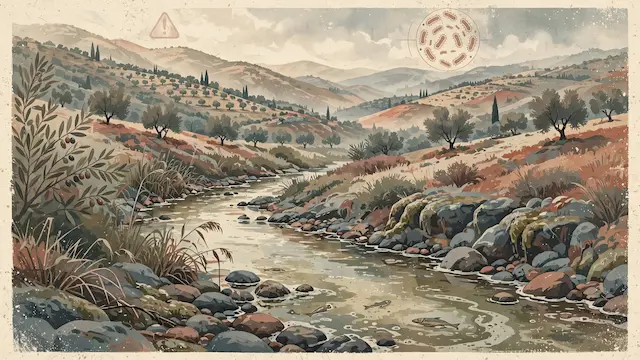
Israel's Ministry of Health and Ministry of Environmental Protection have issued a warning to the public, regional councils, and local authorities regarding exceptionally high levels of bacterial contamination found in several northern rivers. Samples taken on October 4-5, 2026, revealed that the concentration of E. coli bacteria in multiple waterways exceeded the Health Ministry's recommended limit of 400 per 100 ml, indicating significant pollution.
Specific locations with elevated readings include Banias River at Kfar Sold Bridge (830), Hatzbani River at the Roman Bridge (800), Gan HaTzivon (660), and the Jordan River confluence walkway (570). The Jordan River itself showed high levels at various points, with readings up to 2,000 at HaHavot HaBashan Bridge. Other affected areas include Hamshushim Pool (2,100), Jalbun (1,900), Zaki (1,050), Yehudiya (500), Tzalmun at HaHaruv Pool (1,040), and Kziv at Ein Hardalit (760).
Consequently, entry into these rivers is considered potentially dangerous until stable, safe sample results are obtained. The affected sections include Banias River at Kfar Sold Bridge, Hatzbani River from the Roman Bridge to the confluence walkway, and the Jordan River from Yusuf Bridge to Arik Bridge, along with Hamshushim Pool, Jalbun, Zaki, Yehudiya, Tzalmun at HaHaruv Pool, and Kziv at Ein Hardalit.
The Ministry of Environmental Protection has not identified a specific source for the pollution. Typically, water samples are collected bi-weekly by Nature and Parks Authority inspectors at fixed points across the Upper Galilee, Golan Heights, and Western Galilee. The ministries stated they will continue sampling and monitoring, issuing updates as needed.
Mentioned