Northern Israel Streams Contaminated, Health Ministry Warns Against Swimming
Translated & summarized from Israel Hayom by baba
Israel's Ministry of Health and Ministry of Environmental Protection have warned against swimming in several northern streams due to high E. coli levels detected in early October. Readings significantly exceeded the recommended limit, particularly along the Jordan River, with up to 2,000 E. coli per 100 ml. The source of the contamination is currently unknown, and warnings will remain in effect until water quality stabilizes.
The story in 6 lines · by baba
- High E. coli levels detected in northern Israeli streams, prompting swimming warnings.
- Jordan River showed particularly high contamination, reaching 2,000 E. coli per 100 ml.
- The source of the contamination in the affected streams is currently unknown.
- Health and Environmental Protection ministries issued specific warnings for multiple popular swimming spots.
- Routine water sampling is conducted by the Nature and Parks Authority.
- Warnings will be lifted once water quality returns to stable, acceptable levels.
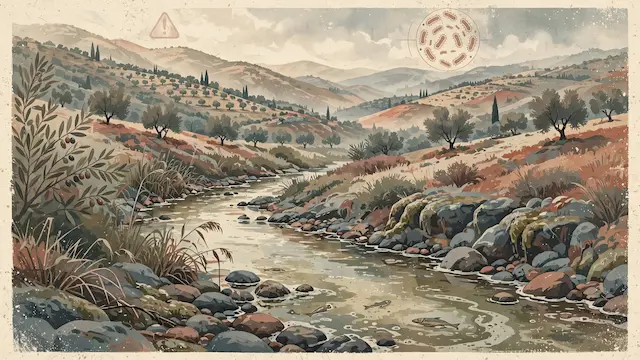
Unusually high levels of E. coli have been detected in several streams in northern Israel, prompting warnings from the Ministry of Health and the Ministry of Environmental Protection against entering the water. Tests conducted on October 4 and 5 revealed bacterial counts exceeding the Health Ministry's recommended limit of 400 E. coli per 100 ml of water in multiple locations.
Significant contamination was found along the Jordan River, with readings as high as 2,000 E. coli per 100 ml near the Lahavot HaBashan bridge. Other affected areas include the Banias River (830), Hatzbani River (800), Gan HaNatziv (660), and the Jordan River confluence promenade (570). The Meshu'shim pool registered a high of 2,100 E. coli, with other elevated readings at Gilbon (1,900), Zachy (1,050), Yehudiya (500), Haruv pool in Tzalmon stream (1,040), and Ein Hardalit in Kaziv stream (760).
The ministries have issued specific warnings for visitors to avoid swimming in the Banias near the Kfar Sold bridge, along the Hatzbani from the Roman bridge to the confluence promenade, and the Jordan River from the Yosef bridge to the Arik bridge. Warnings also apply to Meshu'shim pool, Gilbon, Zachy, Yehudiya, Haruv pool, and Ein Hardalit.
The Ministry of Environmental Protection stated that the source of the contamination is currently unknown. Routine water sampling is conducted every two weeks by the Nature and Parks Authority. The ministries will continue monitoring the streams and will lift the warnings once test results return to stable, acceptable levels. The public can access quarterly sampling results on the Ministry of Health website and a map of sampled streams.
Mentioned