
Israel Uses Antiquities Designations to Restrict Palestinian Land Use
Translated & summarized from Local Call by baba
Israel is increasingly using declarations of "historical sites containing antiquities" to restrict Palestinian land use in the West Bank. These designations, often applied to agricultural lands, limit farming activities and are viewed by activists as a strategy to expand Israeli control and facilitate eventual annexation, bypassing direct land confiscation procedures. Legal challenges against such orders are considered difficult due to consistent judicial validation of military directives.
The story in 5 lines · by baba
- Israel is designating Palestinian lands as "historical sites containing antiquities" to restrict their use.
- Activists claim these designations are a tool for expanding Israeli control and eventual annexation.
- The notices limit Palestinian farmers' ability to cultivate their lands and use agricultural machinery.
- Legal challenges against these orders are difficult due to consistent judicial validation.
- The trend is seen as a form of "spatial freezing" to gradually push Palestinians off their land.
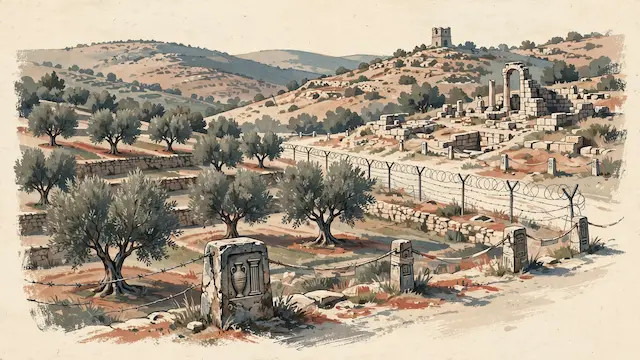
Recent weeks have seen the posting of at least 15 official notices across the West Bank, primarily in areas near Qalqilya, Tulkarm, and Salfit. These notices, signed by Benjamin Har Even, the Antiquities Staff Officer in the Civil Administration, and Hillel Rot, Deputy Head of the Civil Administration, declare specific sites, such as "Khirbet Nofel," "Khirbet al-Nasheh," and "Khirbet Pardusi," as "historical sites containing antiquities." While ostensibly a measure for cultural preservation, Palestinian farmers view these declarations as bureaucratic barriers that restrict their access to and use of their ancestral lands, particularly ahead of the olive harvest. These declarations affect significant land areas, with one notice alone covering 988 dunams east of Tulkarm, and the total area covered by the 15 notices reaching 2,169 dunams. Critics, including Palestinian and Israeli activists, argue that these archaeological designations are being used as a tool to expand Israeli control over Palestinian territories. For instance, in Jius, a village that previously fought a lengthy legal battle to regain access to lands separated by the separation barrier, these new notices are seen as an attempt to circumvent previous legal victories. In some cases, like at Khirbet al-Nasheh, the notices prevent landowners from using agricultural machinery. Activists also point to the geopolitical implications, suggesting these declarations create buffer zones along the Green Line, near Israeli settlements like Tzofim Yigal and Kokhav Ya'ir. Farmers report that the combination of separation barrier gates, strict permit policies, and these new archaeological orders disrupts essential seasonal agricultural work, leading to reduced yields and environmental degradation. The head of the Qarawat Bani Hassan village council stated that notices have been posted on 11 inhabited homes, potentially endangering them with administrative demolition orders. Amir Daoud of the Anti-Wall and Settlements Committee noted that while these notices do not constitute immediate property confiscation, they significantly limit land use, construction, and cultivation. Alon Arad, CEO of Emek Shaveh, highlighted that since 1967, Israel has declared thousands of sites in the West Bank as archaeological or historical, but the recent practice of posting older notices is a new phenomenon. Arad fears these declarations are a precursor to further land appropriation, allowing authorities to claim ignorance was not a factor. Kamar Msharqi-Asad, co-director of Hekel, for the Protection of Human Rights, describes this strategy as "spatial freezing," where archaeological designations serve as a planning anchor to prevent Palestinian development and gradually push them off their land without the legal and financial obligations of direct expropriation. This trend aligns with efforts by the government, particularly Heritage Minister Amihai Eliyahu, to use archaeology as a pretext for annexing West Bank territories. Despite international law and the Oslo Accords prohibiting archaeological excavations in occupied territories except for rescue operations, the current Israeli government is reportedly attempting to bypass these restrictions. Recent legislative proposals aim to establish an independent "Judea and Samaria Heritage Authority" to manage archaeological affairs in Area C and parts of Area B. The Civil Administration stated that the posting of these notices is part of its work plan to protect historical sites and raise public awareness, emphasizing that they are not expropriation orders and do not alter existing property rights, and that all notices are in Area C only.
Recent government actions also include the expropriation of over 2,000 dunams of land near Sebastia for "archaeological site development" and the expropriation of a mosque and 109 dunams around it in Nabi Samwil. These actions are framed by officials like Heritage Minister Amihai Eliyahu as reclaiming Jewish historical connection to the land, with one official stating "there is no Palestinian people, therefore there are no Palestinian heritage sites." Legal experts express concern that Israeli courts consistently legitimize these military orders, making it difficult to challenge them. The situation in Wadi Qana is cited as an example, where strict environmental regulations, ostensibly for preservation, limit Palestinian agricultural activities while settlements expand around the valley. Data indicates that while Palestinian agriculture faces restrictions, Israeli authorities have allocated significant land within protected areas for settlement housing, with untreated sewage from settlements polluting Palestinian farmlands without recourse for local farmers.