Expert Warns of European Airports: "This is Where the Danger Lies"
Translated & summarized from Vesty by baba
The story in 6 lines · by baba
- No single Israeli agency holds full responsibility for foreign flight security.
- State Comptroller warned of aviation security gaps two years ago.
- Recommendations for a unified security body have been repeatedly delayed.
- Officials are shifting blame after a thwarted terror attempt on Flydubai.
- Former officials criticize the lack of action and fragmented system.
- Future threats may emerge from less secure smaller airports.
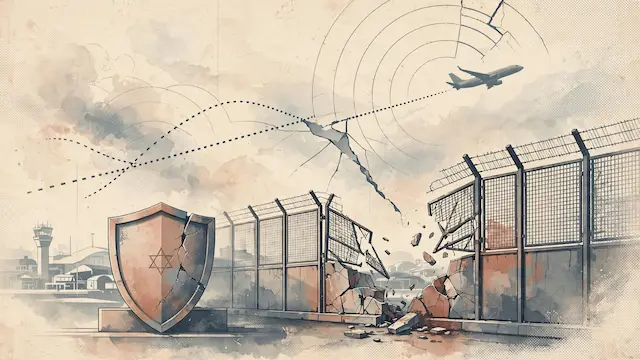
An attempted terrorist attack on a Flydubai flight to Israel on September 30 was thwarted, with the incident concluding without harm. However, the event has exposed a systemic issue where no single government body holds full responsibility for security, Ynet reported on October 4. The State Comptroller had warned of this problem two years prior, but recommendations to establish a unified coordinating body were delayed, and currently, the Ministry of Transport, Shin Bet, the National Security Council, and the Prime Minister's Office are reportedly shifting blame among themselves.
Daily, dozens of foreign airline flights land in Israel carrying numerous Israeli citizens. The security systems for these flights differ fundamentally from those on El Al, Arkia, and Israir flights, a fact most passengers are unaware of. The incident on Flydubai flight FZ1073 raised the question of who is actually vetting these aircraft and their crews.
Ynet examined the State Comptroller's findings, the authorities' actions post-report, and interviewed former senior security officials Dani Shenar and Eyal Hulata. Shenar, who led the Ministry of Transport's security department for 25 years, and Hulata, a former National Security Advisor, both criticized the lack of progress.
In May 2024, State Comptroller Matanyahu Engelman published a report on aviation security, highlighting significant gaps, particularly concerning foreign airlines. His main recommendation was for the National Security Council to lead a joint effort with various ministries and agencies to reformulate a unified aviation security policy. Shenar stated the Comptroller was entirely correct, emphasizing the need for a state authority beyond the Ministry of Transport's operational center (MAMLAT). Hulata called the lack of action since the report a "glaring failure."
Legally, the Ministry of Transport is responsible for assessing threats and issuing security instructions to foreign airlines. However, Shenar described the current system as chaotic, with security divided among seven entities, and MAMLAT handling only about 20% of the sector. The Ministry of Transport acknowledged its limitations, stating it lacks intelligence-gathering tools and relies on departure country measures and airline assurances. A Haaretz report also highlighted a potential conflict of interest involving Avri Cohen, head of the Ministry of Transport's security department, who also works for a foreign airport security service related to Israeli airlines.
The idea of a unified aviation security authority has been proposed since at least 2011. Former proposals, including one presented to Prime Minister Benjamin Netanyahu in 2011, were reportedly rejected. Hulata placed direct responsibility on Netanyahu for not addressing the issue. While the Ministry of Transport claims to support the creation of a unified body, its implementation requires government decisions that have not materialized.
Limited measures have been taken, including budget allocation for MAMLAT's computer systems and a shift in responsibility for charter flights on foreign aircraft from Shin Bet to the Ministry of Transport starting in 2026, despite the ministry's objections.
Shenar explained that private planes are more thoroughly checked because it's simpler, contrasting this with past Israeli aviation security models that were studied internationally. He dismissed concerns about the feasibility of vetting crews, stating technology allows for rapid checks. However, the Ministry of Transport admitted it did not receive the crew list for the Flydubai flight and lacks access to such lists, relying instead on the airline's written assurances.
Following the incident, blame was exchanged. A National Security Council document from the previous year reportedly blamed the Ministry of Transport, while Hulata pointed to Dubai as the first line of defense and criticized the lack of even random checks by the Ministry of Transport. He also noted that Israel had not allowed its airlines to fly to the UAE due to disagreements over security screening.
Prime Minister Netanyahu acknowledged a failure five days after the incident and tasked the current head of the National Security Council to conduct a thorough review of foreign aviation security. Shenar warned that future threats might emerge from smaller, less secure airports in peripheral areas and on islands, urging the creation of a unified security body and immediate measures like requiring foreign pilot names for intelligence checks.
He stressed that relying on luck is not a viable long-term strategy, especially given the potential for instability in the current system.
Mentioned
The same event, reported separately by each outlet. Open a few to compare what different newsrooms emphasize — and what they leave out.
Centre 5Right 3Other 2









Not the same event — other stories that share this one’s people, places, or theme: background, reactions, and follow-ups.