Israel's Aviation Security System Criticized After Near-Miss Incident
Translated & summarized from Ynet by baba
The story in 5 lines · by baba
- Israel's aviation security system suffers from fragmented responsibility and unaddressed failures.
- A State Comptroller's report from 2024 detailed serious deficiencies in foreign airline security.
- Former officials criticize the lack of action and the diffusion of responsibility among agencies.
- Concerns exist about security at smaller European airports, posing a risk to flights to Israel.
- Prime Minister Netanyahu has ordered a review of foreign civil aviation security.
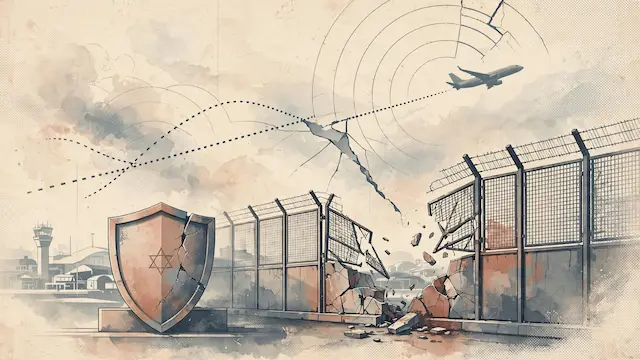
A foiled security incident on a Fly Dubai flight to Israel has exposed significant gaps and a lack of clear responsibility within the country's aviation security system. Despite a State Comptroller's report two years ago highlighting these issues and recommending a consolidated oversight body, recommendations have been shelved, with the Ministry of Transport, Shin Bet, National Security Council (NSC), and Prime Minister's Office reportedly passing responsibility among themselves.
The incident, which occurred on Fly Dubai flight FZ1073, raised questions about who is responsible for vetting foreign airline crews and aircraft arriving in Israel. Unlike Israeli airlines like El Al, Arkia, and Israir, foreign carriers operate under different security protocols, often relying on security measures in their countries of origin.
A State Comptroller's report in May 2024, covering 2022-2023, detailed serious deficiencies in aviation security, particularly concerning foreign airlines. The report's central recommendation was for the NSC to lead a multi-agency effort, including the Ministry of Transport, Ministry of Finance, Israel Airports Authority, Shin Bet, and police, to formulate a comprehensive aviation security policy. However, former officials Dani Shenar and Eyal Hulata stated that no action has been taken since the report's release, calling it a "sky-high failure."
Legally, the Ministry of Transport's Security, Emergency, and Cyber Division, through its Aviation Security Operations Center (ASOC), is responsible for the security vetting of foreign flights. However, Shenar explained that actual security is fragmented among seven different bodies, leading to confusion. The Ministry of Transport itself stated it lacks the intelligence capabilities for background checks, relying instead on foreign airlines' assurances and overseas security.
Concerns have also been raised about potential conflicts of interest, with reports indicating that the head of the Ministry of Transport's Security Division, Avri Cohen, holds a paid position overseeing security for Israeli airlines at a foreign airport, a role approved in 2018. Furthermore, a proposal from 2011 to establish a state authority for aviation security, which Shenar led, was reportedly rejected by Prime Minister Benjamin Netanyahu after a lengthy discussion.
While some minor improvements have been made, such as dedicated funding for ASOC computer systems and a shift in responsibility for chartered flights to the Ministry of Transport starting in 2026, the core issues remain unaddressed. Shenar warned that the real danger lies in flights from smaller, peripheral airports in places like Greece, which have weaker security measures and pose a significant risk to flights arriving in Israel. He stressed the need for immediate fact-finding and the long-term establishment of a national security body, along with basic measures like screening foreign pilots.
Following the incident, the NSC internally noted the Ministry of Transport's failure to fulfill its role. Hulata pointed to Dubai as the first line of defense, stating that the vetting of the Omani pilot should have prevented the incident. Prime Minister Netanyahu has since acknowledged the lapse and instructed the current head of the NSC to appoint an examiner to thoroughly review all aspects of foreign civil aviation security to Israel.
Mentioned
The same event, reported separately by each outlet. Open a few to compare what different newsrooms emphasize — and what they leave out.









Not the same event — other stories that share this one’s people, places, or theme: background, reactions, and follow-ups.