
Israel to Bolster Naval Capabilities Amid Rising Maritime Threats
Translated & summarized from Channel 9 by baba
Prime Minister Benjamin Netanyahu announced on October 4 that Israel will significantly enhance its naval capabilities, aiming to become a global leader in underwater and surface warfare. This move comes amid rising threats from Iran and the Houthis in key maritime chokepoints and the Mediterranean Sea, necessitating a broader role for the Israeli Navy beyond coastal defense.
The story in 5 lines · by baba
- Israel plans major naval expansion to counter growing maritime threats.
- Prime Minister Netanyahu aims for global leadership in naval warfare.
- New threats from Iran and Houthis cited as key motivators.
- Israel's sixth submarine, the 'Dolphin,' recently arrived.
- Naval role expanding from coastal defense to power projection.
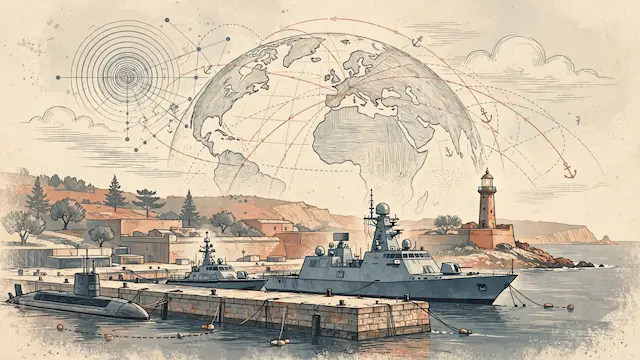
Israel plans to significantly enhance its naval capabilities in response to escalating maritime threats, with Prime Minister Benjamin Netanyahu vowing to position the nation among global leaders in surface and underwater warfare. Netanyahu made these remarks on October 4 during a visit to the Ashdod naval base, where he and Defense Minister Israel Katz received a briefing on the maritime situation and inspected naval armaments. The Prime Minister stated that maritime space has become an international battlefield, citing threats to shipping in the Strait of Hormuz from Iran and in the Bab el-Mandeb strait from the Houthis. "Our enemies want to threaten our maritime space in the Mediterranean Sea, our seaports, maritime traffic," Netanyahu declared, adding, "Of course, we will not allow this to happen."
Netanyahu revealed that security officials have requested additional submarines, ships, and other assets, the specifics of which he could not disclose for security reasons. He noted that Israel's sixth submarine, the "Dolphin," had arrived and that more submarines and unspecified "other means" were desired. He reiterated Israel's ambition to become "one of the world leaders" in both surface and underwater combat.
The "Dolphin" submarine, the sixth in Israel's fleet, arrived at the Haifa naval base on September 24. It is the third and final submarine of the Dolphin AIP class acquired from the German company TKMS. According to the IDF, this submarine is equipped with advanced technologies enhancing its stealth, operational flexibility, and overall fleet capabilities.
The expansion of naval forces extends beyond defending Israel's coast. The maritime domain has become a critical element of regional confrontation, with Iran threatening shipping in the Strait of Hormuz and Iran-backed Houthis posing risks in the Red Sea and Bab el-Mandeb strait. Simultaneously, Israel must protect its ports, merchant shipping, and strategic assets in the Mediterranean Sea.
In early September, Commander of the Israeli Navy Vice Admiral Eyal Harel warned that Israel would not permit adversaries to alter the balance of power in the Mediterranean and Red Seas or jeopardize its freedom of maritime operations. Historically, the Israeli Navy has been secondary in importance to the ground forces and air force within the IDF. However, evolving threats necessitate a reassessment, requiring the navy not only to ensure coastal security but also to project power far beyond Israel's borders, both on and under the water. Netanyahu's announcement signals a clear direction toward further fleet expansion, encompassing not only submarines but also additional surface vessels and undisclosed equipment.
Mentioned
The same event, reported separately by each outlet. Open a few to compare what different newsrooms emphasize — and what they leave out.
Centre 1Right 6Haredi 3Arab 3Other 3

















Not the same event — other stories that share this one’s people, places, or theme: background, reactions, and follow-ups.
