
Gaza's Economic Collapse Requires Production Revival, Not Just Reconstruction
Translated & summarized from Panet by baba
A UNCTAD report states Gaza's economy has lost most of its productive capacity, with 92% of facilities damaged. True recovery requires prioritizing production and employment over mere reconstruction, alongside lifting movement restrictions and addressing the Palestinian financial crisis.
The story in 5 lines · by baba
- Gaza's economy has lost most productive capacity, with 92% of facilities damaged.
- Economic recovery hinges on reviving production and employment, not just rebuilding.
- Freedom of movement and trade are essential for economic revival.
- Reconstruction funding must build sustainable productive capacity.
- Addressing the Palestinian financial crisis is crucial for economic activity.
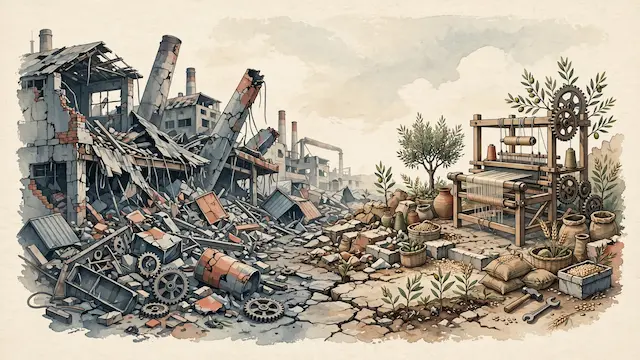
A recent UNCTAD report highlights that Gaza's economy has lost most of its productive and income-generating capacity, with 92% of its economic facilities damaged or destroyed. Per capita income has fallen to $212 annually, indicating an economic crisis that has eroded the foundation for recovery. The report emphasizes that reconstruction funding alone will not achieve economic recovery unless production and employment are prioritized. The focus should be on restarting remaining facilities, restoring agricultural and industrial activity, and providing energy, raw materials, and financing, while involving local producers and workers in reconstruction projects. Every dollar spent should be measured by its ability to create added value and jobs.
However, investment is insufficient without addressing restrictions on movement and trade. The free movement of people and goods, along with access to markets and production inputs, is crucial for any recovery. Therefore, freedom of movement and trade are direct prerequisites for the revival of factories, farms, and markets, not separate political demands.
Reconstruction should not create an aid-dependent economy with temporary contracts. Funding must be directed towards building sustainable productive capacities, supporting small and medium-sized enterprises, and linking reconstruction to employment, training, and knowledge transfer to ensure lasting impact. Addressing the Palestinian financial crisis, including Israeli revenue seizures and deductions, is also essential for the government to provide services and support the private sector and banking system.
UNCTAD estimates recovery and reconstruction needs at $71.5 billion. The international community's responsibility extends beyond providing funds to ensuring they are directed towards genuine recovery. The challenge is not just rebuilding destroyed infrastructure but restoring Gaza's economy as a source of work, income, and stability. Ultimately, Gaza needs to rebuild its productive capacity, as a functioning economy, not just buildings, is what allows people to regain their lives and dignity.
Not the same event — other stories that share this one’s people, places, or theme: background, reactions, and follow-ups.
