
Netherlands Shifts from Israeli Ally to Critic Amid Gaza War and Shifting Politics
Translated & summarized from Al-Shams by baba
The Netherlands has shifted from a close ally to a critic of Israel, implementing a ban on settlement products and facing diplomatic repercussions. This change is driven by the Gaza war, evolving public opinion, and internal political dynamics, particularly within the Dutch Foreign Ministry.
The story in 5 lines · by baba
- Netherlands bans products from Israeli settlements, citing international law.
- Israel retaliates by revoking diplomatic documents for Dutch diplomats.
- Gaza war and evolving Dutch public opinion fuel the policy shift.
- Internal political changes and Foreign Ministry professionals influence stance.
- Netherlands acts unilaterally as EU consensus remains elusive.
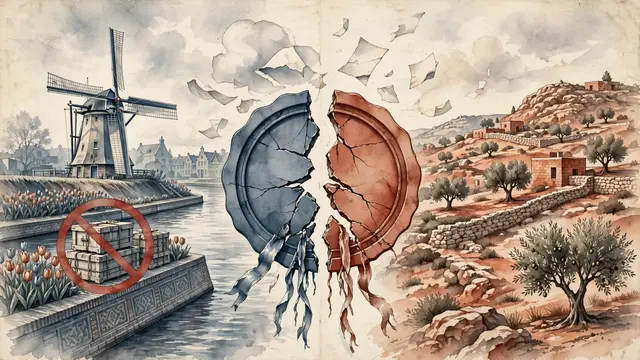
The Netherlands has undergone a significant shift in its relationship with Israel, transforming from a decades-long close ally to one of Europe's leading voices advocating for practical measures against Israeli policies in the West Bank. This change is attributed to the Gaza war, evolving Dutch public opinion, political shifts in The Hague, and the growing influence of professionals within the Dutch Ministry of Foreign Affairs, according to an analysis by "Wient".
A recent manifestation of this tension is a Dutch decree, effective September 22, that prohibits the import, purchase, sale, and commercial brokerage of products originating from Israeli settlements in the West Bank, East Jerusalem, and the Golan Heights, which the Netherlands deems "illegal settlements." This ban is set to last for three years, with potential criminal prosecution for violations. The Dutch government acted unilaterally after failing to achieve consensus within the European Union, as EU foreign policy decisions require broad support from all 27 member states.
The decree extends beyond businesses and importers, encompassing products in travelers' personal luggage, including gifts and souvenirs. This has led to reports of Israeli travelers at Amsterdam's Schiphol Airport being questioned about settlement-originating items during inspections.
In response, Israel has taken diplomatic action. Foreign Minister Gideon Sa'ar announced that Dutch diplomats working with the Palestinian Authority in Ramallah, some of whom reside in Israel, will be required to return their Israeli-issued diplomatic documents, with their privileges and immunities expiring after a specified period. Dutch Foreign Minister Tom Brandsen expressed regret over Israel's decision, calling it unnecessary and emphasizing that the settlement product ban is not aimed at Israel but stems from The Hague's commitment to not contributing to situations considered violations of international law.
Further diplomatic friction arose when Israel's ambassador to the Netherlands, Tsvee Avivi, was summoned to the Dutch Foreign Ministry for a reprimand following Israel's retaliatory measures, including the revocation of diplomatic documents for Dutch mission members in Ramallah. The Netherlands also protested a prior Israeli action that barred Dutch representatives from the international coordination center for Gaza in Kiryat Gat.
Historically, the Netherlands was one of Israel's closest European allies, providing support during the 1973 Yom Kippur War and representing Israeli interests in Moscow. Even after cutting ties with the Soviet Union, the Netherlands maintained an embassy in Jerusalem until 1980. During the 14-year tenure of Prime Minister Mark Rutte, relations remained strong, despite Dutch criticism of Israeli policies.
The analysis suggests that the shift in Dutch policy predates the October 7, 2023, attacks. Israel noted a growing critical trend within the professional ranks of the Dutch Foreign Ministry approximately 15 years ago, with The Hague beginning to warn companies about economic activities in settlements. For a long time, a gap existed between the political level, which maintained relatively close ties with Israel, and the professional level within the Foreign Ministry, which prioritized international law, human rights, and the settlement issue. However, these two perspectives have converged in recent years.
The Gaza war significantly altered the landscape. In the initial months after October 7, Dutch public opinion showed relative support for Israel's right to self-defense, with a November 2023 poll indicating 68% believed Israel had this right, and about three-quarters blamed Hamas for the war's outbreak. However, 48% felt Israel's military response was disproportionate, reflecting a dual perspective in Dutch society: acknowledging Israel's attack while increasingly criticizing its conduct of the war.
As the war continued, Dutch public opinion grew more critical of Israel. An April 2025 Ipsos I&O poll revealed that over half of respondents wanted the Dutch government to adopt a more critical stance toward Israel, though a majority still held Hamas largely responsible for the renewed fighting. The analysis posits that, alongside the Gaza war, the expansion of settlements, the promotion of the E1 plan, and increased settler violence against Palestinians have intensified political pressure within the Netherlands for action against Israel.
Internal dissent within the Dutch establishment also emerged during the war, with Foreign Ministry staff and former diplomats participating in protests against government policy, demanding greater pressure on Israel. Former Foreign Minister Kaspar Veldkamp was a key figure advocating for a shift from criticism to political action. He previously served as the Dutch ambassador to Israel and pushed the EU to investigate potential Israeli violations of the human rights clause in its partnership agreement with the EU. Veldkamp also supported a travel ban on ministers Itamar Ben-Gvir and Bezalel Smotrich and called for expanded measures against Israel before resigning due to a lack of government support for additional sanctions.
The new minority government, led by Rob Jetten of the progressive liberal D66 party, was sworn in February 2026. This government relies on outside leftist parties for support on several issues. The analysis links internal political shifts to the hardening stance on Israel, noting polls showing the rise of the "Progressief Nederland" party, a merger of Green and Labour parties, which attracted some D66 voters who felt the government's policies were not sufficiently leftist. The article clarifies that this political trend does not signify a complete leftward shift of Dutch society, as a significant right-wing bloc remains. However, divisions within the right, including disagreements related to Geert Wilders' party, complicate the formation of stable coalitions and increase the minority government's dependence on external votes.
Israeli officials attribute the Dutch policy shift to political and institutional factors, including the Netherlands' long-standing emphasis on international law and human rights, and its governments' desire to play an active international role. The Hague hosts the International Court of Justice and the International Criminal Court, amplifying the presence of international law issues in public and political discourse. Internal pressures, including a large Muslim community and a strong progressive-leftist movement, have made the Gaza war and events in the West Bank central to public debate.
The Dutch government maintains that its actions are not directed at Israel as a state but are a response to settlement expansion, West Bank violence, and its perceived international legal obligations. Other European nations remain more cautious than the Netherlands. Australia has considered similar steps but has not yet imposed a comprehensive ban on settlement products, and there is no EU-wide consensus. While EU foreign ministers discussed options like import licensing, high tariffs, or a full trade ban with settlements in July, no clear majority emerged. Germany's position is crucial for any joint European action; its absence makes a unified EU policy difficult. The Netherlands, France, and other countries can still act individually. The analysis concludes that the Netherlands currently represents the most advanced case within an emerging trend in other European countries, leaving open the question of whether it will become a model or remain an exception.
Mentioned
The same event, reported separately by each outlet. Open a few to compare what different newsrooms emphasize — and what they leave out.
Centre 2Right 1Haredi 1Arab 1Other 1






Not the same event — other stories that share this one’s people, places, or theme: background, reactions, and follow-ups.
