
Ancient Ritual Bath Moved Intact in Remarkable Engineering Feat
Translated & summarized from Behadrei Haredim by baba
Archaeologists in Kiryat Gat have successfully relocated a 2,000-year-old mikveh, discovered during development work, using a complex engineering operation involving a heavy-lift crane. The ancient ritual bath will be preserved and later displayed in a public area of the new neighborhood.
The story in 5 lines · by baba
- A 2,000-year-old mikveh was moved intact using a 300-ton crane.
- The mikveh provides evidence of a previously unknown Jewish settlement.
- The relocation was necessary to protect the artifact during construction.
- The structure will be reinstalled in a public space in the new neighborhood.
- The operation involved extensive engineering and conservation efforts.
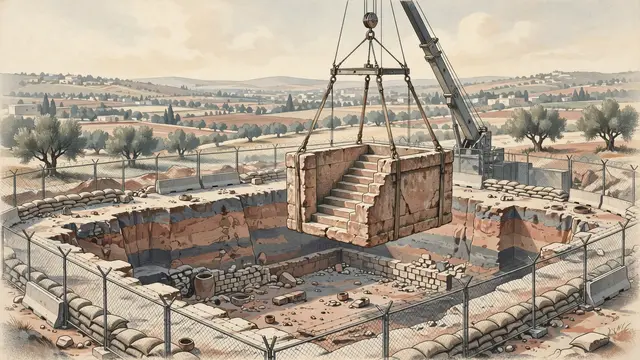
An exceptionally rare engineering operation has successfully relocated a nearly 2,000-year-old mikveh, or Jewish ritual bath, discovered during archaeological excavations in the Kiryat Gat neighborhood of Karmei Gat. The ancient structure, weighing approximately 25 tons and measuring about 4 meters wide, was lifted by a 300-ton crane and moved to state storage facilities. This move was necessary to protect the mikveh from damage during ongoing development work in the area.
The mikveh, dating back to the Second Temple period, provides evidence of a previously unknown Jewish settlement in the region. Alongside the mikveh, archaeologists also found stone measuring cups, which were commonly used by Jews during that era due to their adherence to certain purity laws. The settlement appears to have been abandoned around the time of the Bar Kokhba revolt, with a new settlement emerging in the Byzantine period with a different population.
The complex relocation process involved extensive preparation by the Israel Antiquities Authority's conservation department. Workers spent two weeks excavating around the mikveh, reinforcing its structure with steel beams inserted through drilled holes, and applying special treatments to its ancient plaster to prevent damage from vibrations during the lift and transport. The entire structure was then braced and strengthened with foam material.
Moving the mikveh required closing roads and utilizing escort vehicles due to its unusual width. The operation was led by senior conservator Eyal Kahou, who described the immense pressure and responsibility involved in such a delicate procedure, emphasizing that there is no room for error. The Minister of Heritage, Rabbi Amihai Eliyahu, stated that the mikveh adds a significant layer to understanding Jewish settlement in the Second Temple period and highlights the state's commitment to preserving heritage during rapid development.
Once the development work in Karmei Gat is completed, the mikveh is slated to be returned and integrated into a public open space within the new neighborhood, allowing residents and visitors to connect with this tangible piece of history.
Mentioned








