
Ancient 2,000-Year-Old Ritual Bath Moved Intact in Complex Engineering Feat
Translated & summarized from Ynet by baba
A 2,000-year-old, 25-ton ritual bath was successfully moved intact from Kiryat Gat to state storage by the Israel Antiquities Authority to protect it from development. The ancient structure will eventually be returned to a public space in the neighborhood.
The story in 4 lines · by baba
- Ancient 25-ton ritual bath moved intact in Kiryat Gat.
- Operation by Israel Antiquities Authority protected structure from development.
- Mikveh provides evidence of 2,000-year-old Jewish settlement.
- Structure will be returned to a public space in the neighborhood.
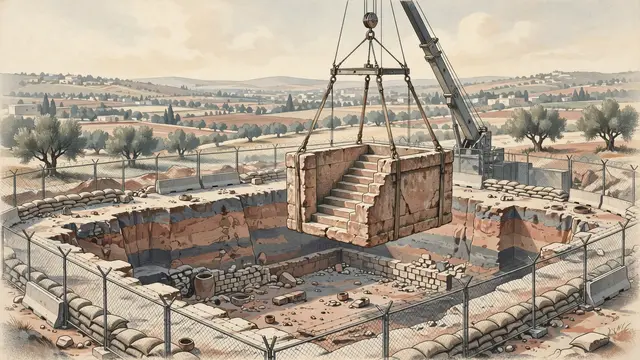
Archaeologists in Kiryat Gat successfully relocated a 2,000-year-old ritual bath, weighing 25 tons and measuring 4 meters wide, in a complex engineering operation. The ancient structure was discovered during excavations in the new Carmei Gat neighborhood.
The Israel Antiquities Authority's conservation department undertook the challenging task to protect the mikveh from ongoing development work. The structure was moved in its entirety to state storage and is slated to be returned to a public space within the neighborhood once construction is complete.
The mikveh, unearthed during salvage excavations funded by the Israel Land Authority at a cost of approximately NIS 28 million, provides clear evidence of a Jewish settlement in the area dating back 2,000 years. Other findings at the site included stone measuring vessels, common among Jews during the Second Temple period.
Excavation directors Elena Kogan Zehavi, Me'ayan Margolis, and Shira Lipschitz stated that this is the first and only known Jewish settlement from that era in the region, located at the junction of the Judean Foothills and the northern Negev. The settlement was likely abandoned during the Bar Kokhba revolt, with a new settlement, comprising a different population, emerging in the Byzantine period.
To move the 25-ton mikveh, conservationists spent two weeks excavating around it and reinforcing it with steel beams and specialized foam. The ancient plaster was protected with gauze and adhesive materials to prevent damage during lifting and transport. A massive 300-ton crane was required due to the distance, and a special trailer was used for the wide load. The road was closed for the convoy, which included escort vehicles.
Eyal Kaho, a senior conservator at the Antiquities Authority, described the operation as high-pressure, emphasizing the need for meticulous planning and the significant responsibility involved. Minister of Heritage, Rabbi Amihai Eliyahu, praised the operation, stating it highlights the state's commitment to preserving heritage during development and will allow residents to connect with tangible evidence of ancient Jewish life.
Mentioned








