not everywhere· Security· Updated
Iran Plans to Target Gulf Internet Cables If War Resumes
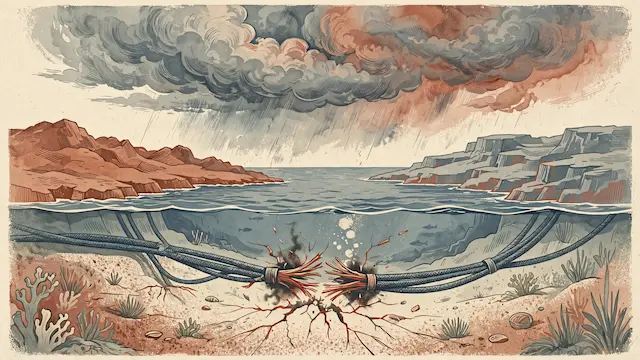
Iran has developed detailed plans to target undersea communication cables in the Persian Gulf if it is attacked by the United States and Israel, according to senior Iranian security officials. The threats, which emerged on Friday, are conditional on the failure of negotiations with the United States and the resumption of conflict.
4 newsrooms · 3 languages · since



What happened
- 01Two senior Iranian security officials revealed detailed plans to target undersea communication cables in the Persian Gulf if attacked by the United States and Israel.
- 02Yadollah Javani, the IRGC deputy head of political affairs, stated on Wednesday that Iran could target seven major internet cables beneath the Strait of Hormuz.
- 03Iranian officials warned that Tehran would actively prevent repairs to the targeted cables to prolong regional communication and internet disruptions.
- 04An anonymous Iranian official warned the United States against playing with fire, declaring that an attack on Iran would leave no red lines.
- 05Experts estimate the global impact of a Strait of Hormuz cable attack would be limited, as less than 1% of international bandwidth passes through it.
- 06The threats are seen as a deterrent to pressure Washington by highlighting risks to digital infrastructure investments made by Gulf states and American companies.
Two senior Iranian officials told Reuters that the Islamic Revolutionary Guard Corps (IRGC) has identified seven major internet cables beneath the Strait of Hormuz as potential targets. Yadollah Javani, the IRGC deputy head of political affairs, stated on Wednesday that these cables could be targeted if Iranian infrastructure is attacked. The officials warned that Iran would also act to prevent any repair efforts in order to prolong disruptions to regional communication networks.
While undersea cables carry approximately 99% of global internet traffic, experts suggest the global impact of an attack in the Strait of Hormuz might be limited, as less than 1% of international bandwidth passes through this waterway. The threats are viewed as a deterrent strategy to pressure Washington by raising concerns among Gulf governments and American companies regarding their regional digital infrastructure investments.
Summarized by baba from the reports of 4 newsrooms. Updated
Latest report: Panet. Read Panet’s originalThe coverage
4 newsrooms on this story
Who covered it
- LeftNone
- Centre3
- RightNone
- HarediNone
- Arab1

Not in the Left, Right or Haredi press


