
Dollar Hits One-Year High Against Shekel Amidst Political and Economic Uncertainty
The U.S. dollar reached a one-year high against the Israeli shekel, trading at approximately 3.28 shekels, a 17% increase in six months. Factors contributing to the shekel's decline include a widening interest rate gap with the U.S., increased political uncertainty, and global dollar strength. The weaker shekel is expected to raise the cost of living due to import prices, though it benefits exporters and those holding dollar assets. The Bank of Israel is unlikely to intervene unless the market movement is economically illogical.
הידיעה ב-5 שורות · תקציר של baba
- The U.S. dollar hit a one-year high against the Israeli shekel, reaching approximately 3.28 shekels.
- The shekel has weakened by 17% against the dollar in the past six months.
- Widening interest rate gaps and political uncertainty in Israel are key drivers of the shekel's decline.
- A stronger dollar is expected to increase the cost of living in Israel due to higher import prices.
- The Bank of Israel is unlikely to intervene in the currency market unless there is an illogical economic movement.
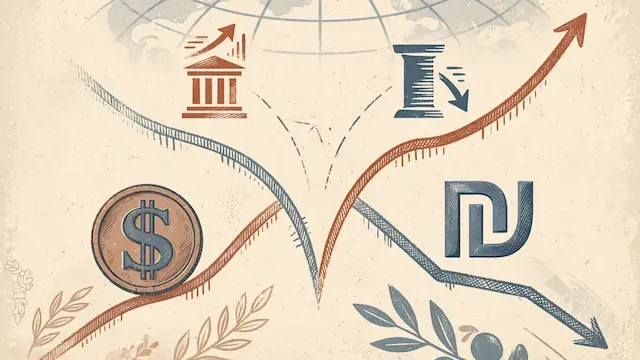
The U.S. dollar surged to a one-year high against the Israeli shekel on Wednesday, reaching approximately 3.28 shekels in continuous trading. This represents a 17% increase from its low of 2.80 shekels about six months ago. The strengthening dollar comes just days before the Bank of Israel is expected to announce its next interest rate decision.
Several factors are contributing to the shekel's weakening. Yossi Menashe, co-founder and co-CEO of Altshuler Shaham Financial Services, points to a widening interest rate gap between the U.S., where rates are rising, and Israel, where they are not, especially after a lower-than-expected inflation index for October. Moody Shapir, Chief Strategist at Bank Hapoalim, also notes an increase in Israel's risk premium, as investors demand higher returns due to concerns that Chairman Gadi Eisenkot may not be able to form a government, potentially leading to new elections.
Globally, the dollar is also strengthening against other major currencies like the Euro and Pound Sterling, with the dollar index reaching its highest level since April 2025. Menashe observes that the shekel is now moving with global trends, unlike in the past when it was an outlier. He also attributes some of the uncertainty to volatility in Nvidia, following its founder Jensen Huang's departure, noting the company's significant impact on the Israeli economy through its role in production and GDP. The high-tech labor market also shows signs of cooling, with more job seekers than available positions reported by the Employment Service.
The weakening shekel has implications for the Israeli economy. Menashe explains that since most goods are imported in dollars, a stronger dollar can trigger inflation and increase the cost of living. This presents a dilemma for the Bank of Israel: a higher dollar raises prices but benefits exporters. Airline ticket prices, denominated in dollars, effectively become more expensive in shekel terms. Conversely, Israelis holding dollar-denominated assets abroad, as well as high-tech and defense companies with dollar revenues, stand to benefit.
Looking ahead, Menashe believes the Bank of Israel is unlikely to intervene in the currency market unless there is an illogical economic movement. The bank typically intervenes by buying dollars to strengthen the shekel, not the other way around. He anticipates the dollar's exchange rate will stabilize after its recent rapid rise, but this depends on many external factors. Shapir adds that many foreign investment managers believe the dollar would fall back to around 3 shekels if Eisenkot succeeds in forming a government.
מוזכרים
אותו אירוע, כפי שכל מערכת דיווחה עליו בנפרד. פתחו כמה דיווחים כדי להשוות מה כל מערכת מדגישה, ומה היא משאירה בחוץ.
סיקור מאת Mako

לא אותו אירוע: ידיעות אחרות שחולקות עם הידיעה הזו אנשים, מקומות או נושא. רקע, תגובות והמשכים.



