
Dollar Hits One-Year High Against Shekel Amid Interest Rate Divergence
The U.S. dollar has climbed to a one-year high against the Israeli shekel, trading around 3.27 shekels. This rise is driven by diverging interest rate policies between the U.S. Federal Reserve and the Bank of Israel, global market volatility, and institutional investor behavior. Factors like U.S. rate hike expectations and Wall Street's downturn strengthen the dollar, while potential market recoveries and shifts in Fed policy could weaken it. The Bank of Israel has the capacity to intervene if necessary.
הידיעה ב-6 שורות · תקציר של baba
- The U.S. dollar reached a one-year high against the Israeli shekel, trading at approximately 3.27 shekels.
- Diverging interest rate policies between the U.S. Federal Reserve and the Bank of Israel are a primary driver.
- Global market volatility, particularly on Wall Street, is increasing demand for the dollar as a safe haven.
- Institutional investors buying dollars to maintain foreign currency exposure are weakening the shekel.
- Geopolitical tensions and high energy prices also contribute to the dollar's strength against the shekel.
- Potential market recoveries and changes in U.S. inflation expectations could lead to a reversal.
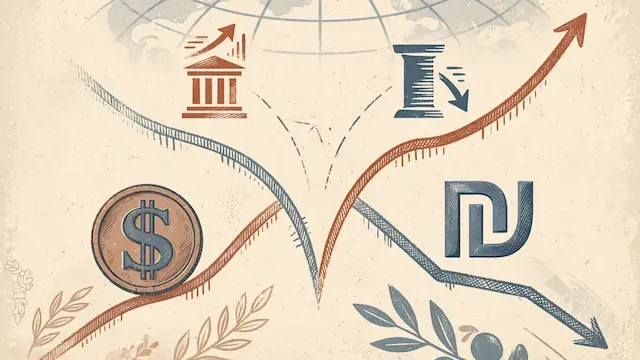
The U.S. dollar has reached a one-year peak against the Israeli shekel, trading around 3.27 shekels per dollar, marking a significant increase from its late October value of approximately 3.10 shekels. This surge is attributed to several factors, primarily the widening interest rate differential between the United States and Israel, volatility in global markets, and the behavior of institutional investors.
The U.S. Federal Reserve is signaling further interest rate hikes, with markets anticipating at least one more increase in December and potentially another in January. Federal Reserve Governor Christopher Waller recently advocated for a half-percentage-point hike in December. In contrast, the Bank of Israel has been lowering its interest rate, which currently stands at 3.25%, with expectations of further reductions due to falling inflation. This divergence makes dollar-denominated assets more attractive than shekel-denominated ones, drawing capital away from the shekel.
Global market turmoil, particularly on Wall Street, is also bolstering the dollar. Declines in major U.S. stock indices, driven by concerns over tech company financing, regulatory risks, and executive departures, have led investors to seek the safety of the dollar. This global trend impacts the Israeli market through institutional investors like pension funds and insurance companies. As their foreign stock holdings decrease in value, they are compelled to buy dollars to maintain their target foreign currency exposure, weakening the shekel.
Geopolitical tensions, especially concerning Iran, and elevated oil prices contribute to the dollar's strength. Higher energy costs increase demand for dollars among importers and raise Israel's risk premium. However, strong exports, particularly from the high-tech sector, help to offset the trade deficit.
Potential factors that could reverse the trend include a recovery in global markets, which would prompt institutional investors to sell dollars and strengthen the shekel. Changes in expectations regarding the Federal Reserve's monetary policy, particularly if U.S. inflation data moderates, could also reduce the dollar's advantage. Furthermore, structural support for the shekel comes from consistent dollar inflows via high-tech exports and potential foreign investments and acquisitions of Israeli companies. The Bank of Israel also possesses substantial foreign currency reserves and has intervened in the past to manage currency fluctuations.
מוזכרים
לא אותו אירוע: ידיעות אחרות שחולקות עם הידיעה הזו אנשים, מקומות או נושא. רקע, תגובות והמשכים.



